
Friday, December 7, 2007

Friday, November 30, 2007
Finding a Place to Begin Again
Sometimes you just have to let go. Does it really matter if I can't recount every little amazing/inspiring/bewildering detail of every noteworthy event to our blog readers? Clearly not. It just took me a while to figure out where to begin again . . .


So much has happened since October 18 - the date we last posted - a staggeringly long time ago. Now here we are on the cusp of December . . . Between galavanting around the Holy Land for work, running more workshops in Khartoum, and keeping up with my parents latest adventures in Nepal, not to mention all our belongings finally being released from Sudanese customs so we could finally unpack - it's been a rather busy few weeks! But that's ok. Because if there's anything I'm learning from all this yoga and peacebuilding stuff that I do, it's that wherever you are today is ok. Whatever you can do is enough. So I'm letting go.
And I'll start bringing in some of the experiences from the last couple of weeks just as I can . . . bit by bit. Let's start with some photos, eh?
Here we are at the pyramids in Meroe:


And let's see . . . here's E on his way to the big Sudan-Tunisia Africa Cup final:


And let's see . . . here's E on his way to the big Sudan-Tunisia Africa Cup final:

And M in Jerusalem:


Thursday, October 18, 2007
Juba Journal - Days 2 and 3
The sun and the roosters get me up early to walk out a bit and get the lay of the city. It was great to see a few young men also out for a jog - not a site you get often in Khartoum. I try to greet every woman I meet on the road have been rewarded with bright gleaming smiles. 100% return rate. Priceless.
Each day we've been in workshops at the ministry of telecommunications, space generously donated for our use by the minister. We travel in a mini bus through roads with potholes that could swallow a Volkswagen. It was all officially launched by the Vice President of Southern Sudan (our lovely host's husband) and the launching of our workshop – Creators of Peace in Sudan.
We've also had some great local women guest speakers and participants. Lots to learn, but also lots being shared. Two more days to go . . .
Each day we've been in workshops at the ministry of telecommunications, space generously donated for our use by the minister. We travel in a mini bus through roads with potholes that could swallow a Volkswagen. It was all officially launched by the Vice President of Southern Sudan (our lovely host's husband) and the launching of our workshop – Creators of Peace in Sudan.
We've also had some great local women guest speakers and participants. Lots to learn, but also lots being shared. Two more days to go . . .
Juba Journal - Day 1
There I was, pushing my way through the crowds to get into the domestic terminal. Once I got inside, I called the group I was traveling with and they told me they were all relaxing in the VIP lounge. So I pushed my way back out again to go join them. You wouldn't think it would be so hard to get to the check-in counter at an airport. But it is. They make everyone go through one door, and only a certain amount of time before your flight. And once they open it up, everyone shoves through together. That's just how it works.
Yeah. And then it's not like I could actually find the VIP lounge . . . everyone I asked sort of rolled their eyes at me. "Stuck-up white girl. Can't even wait with the rest of us in the normal waiting room. We even have free wi-fi there. Isn't that enough for her??"
Eventually my friend took pity on me and came out to find me.
After a couple hours they drove us in the special VIP bus the 50 meters out to our plane. The disadvantage of VIP treatment for wannabe VIPs is that there's no assigned seating for coach class on these domestic flights, and the real VIPs all have first class tickets. So everyone else who had pushed their way through the front door had already pushed their way onto the plane and taken up the first 20 rows. by the time I made my way down the aisle, there actually wasn't a seat left for me.
And that's what jump seats are for. So I got to sit way back up in the front with my knees squeezed between the knees of three other unlucky men who were also without seats.
When we touched down in Juba it was all tall grasses, orange dirt, rolling hills, and the bumpiest roads. But the air was fresh, it was a bit cooler than Khartoum, and there was GREEEEEEENNN!
From the airport, we stopped at three perfectly (well, perhaps imperfectly) functional hotels. (who knew?!) until we settled on the Beijing Juba Hotel. Not exactly an original name . . . We drop our bags and enjoy a lunch of - you guessed it - Chinese food. Not bad all in all. Our room is basically a container: pre-fab, modular units joined end to end to end to make three separate LOOOONNNNGGGG hallways of rooms. We spent the afternoon at work: meetings and planning for the workshop. Then as evening fell, we gathered at the superbly picturesque DaVinci restaurant/bar on the Nile (It’s the White Nile down here, the one that flows out from Uganda.). I don't think I’ve ever seen a more romantic place – or maybe it’s just that I’ve been in a compound in Khartoum for so long that I’ve lost perspective . . .
Anyway, a full day with lots of surprises, but it ended well as we sat under the stars listening to the Nile gurgle by.
Yeah. And then it's not like I could actually find the VIP lounge . . . everyone I asked sort of rolled their eyes at me. "Stuck-up white girl. Can't even wait with the rest of us in the normal waiting room. We even have free wi-fi there. Isn't that enough for her??"
Eventually my friend took pity on me and came out to find me.
After a couple hours they drove us in the special VIP bus the 50 meters out to our plane. The disadvantage of VIP treatment for wannabe VIPs is that there's no assigned seating for coach class on these domestic flights, and the real VIPs all have first class tickets. So everyone else who had pushed their way through the front door had already pushed their way onto the plane and taken up the first 20 rows. by the time I made my way down the aisle, there actually wasn't a seat left for me.
And that's what jump seats are for. So I got to sit way back up in the front with my knees squeezed between the knees of three other unlucky men who were also without seats.
When we touched down in Juba it was all tall grasses, orange dirt, rolling hills, and the bumpiest roads. But the air was fresh, it was a bit cooler than Khartoum, and there was GREEEEEEENNN!
From the airport, we stopped at three perfectly (well, perhaps imperfectly) functional hotels. (who knew?!) until we settled on the Beijing Juba Hotel. Not exactly an original name . . . We drop our bags and enjoy a lunch of - you guessed it - Chinese food. Not bad all in all. Our room is basically a container: pre-fab, modular units joined end to end to end to make three separate LOOOONNNNGGGG hallways of rooms. We spent the afternoon at work: meetings and planning for the workshop. Then as evening fell, we gathered at the superbly picturesque DaVinci restaurant/bar on the Nile (It’s the White Nile down here, the one that flows out from Uganda.). I don't think I’ve ever seen a more romantic place – or maybe it’s just that I’ve been in a compound in Khartoum for so long that I’ve lost perspective . . .
Anyway, a full day with lots of surprises, but it ended well as we sat under the stars listening to the Nile gurgle by.
Tuesday, September 25, 2007
Coming home to a foreign land
Last week E and I returned home from a trip to South Africa. He had a conference there, and since I telecommute, I decided I could work just as well from a hotel with Internet connection in Cape Town as from my townhouse in Khartoum, so we were off! Plus, we would have the nights and weekends to do some exploring . . .
We'll definitely share more about the SA trip as we get the photos and video together. Suffice it to say for now that:
Animals were seen.
Arts and crafts were purchased.
Wine was "tasted."
Table Mountain was climbed (yes, that's a good story for another time).
Fun was had.
But what I wanted to write about today was the experience of coming home from one exotic destination to another foreign location. There is something so sweet about arriving in a place that is so different from the culture you grew up in, and yet that still begins to feel like it too is your Home. It really gets you thinking about what Home is after all.
I mean, technically, it should be where my family is. But If I spent my time here thinking of Summit County, (and Denver, Los Angeles, Fayetteville, or the Twin Cities) as our only home, I think I'd end up feeling dissatisfied with the present, achingly nostalgic, and just generally antsy. On the other hand, if I can start to think about a multitudinous concept of home, as a place where you live (for the time being), and where there are people you love and who love you . . . then a whole world of Home can open up.
And that's the experience I've been having this past week. Things are familiar, but still strange, comfortable, but still surprising, ordinary, but extraordinary. We're reaching for our cameras again, everything seems freshly noteworthy.
An image from our home here for you to "take home" with you:
When you greet people here, you can get into a seemingly endless exchange of questions, check-ins, blessings on your health, your family, etc. It's great really. But when you don't have facility with the language, or if you happen to be speaking to a Sudanese person whose native language is one of the 80-some non-Arabic languages in this country, then what can you do to be culturally sensitive?! (I mean clearly, when the exchange of greetings can go on for many minutes, it is not a minor part of the culture of communication here!) Not to worry, there's a gesture that seems to be another foolproof way to get a smile and connect with the people of Sudan - from the kids playing ball in the street to the ancient man on the stoop on the corner: you make eye contact, smile gently, and put your right hand on your heart. If you know a word of greeting, great. If not, it's ok. This gesture seems to say it all.
We'll definitely share more about the SA trip as we get the photos and video together. Suffice it to say for now that:
Animals were seen.
Arts and crafts were purchased.
Wine was "tasted."
Table Mountain was climbed (yes, that's a good story for another time).
Fun was had.
But what I wanted to write about today was the experience of coming home from one exotic destination to another foreign location. There is something so sweet about arriving in a place that is so different from the culture you grew up in, and yet that still begins to feel like it too is your Home. It really gets you thinking about what Home is after all.
I mean, technically, it should be where my family is. But If I spent my time here thinking of Summit County, (and Denver, Los Angeles, Fayetteville, or the Twin Cities) as our only home, I think I'd end up feeling dissatisfied with the present, achingly nostalgic, and just generally antsy. On the other hand, if I can start to think about a multitudinous concept of home, as a place where you live (for the time being), and where there are people you love and who love you . . . then a whole world of Home can open up.
And that's the experience I've been having this past week. Things are familiar, but still strange, comfortable, but still surprising, ordinary, but extraordinary. We're reaching for our cameras again, everything seems freshly noteworthy.
An image from our home here for you to "take home" with you:
When you greet people here, you can get into a seemingly endless exchange of questions, check-ins, blessings on your health, your family, etc. It's great really. But when you don't have facility with the language, or if you happen to be speaking to a Sudanese person whose native language is one of the 80-some non-Arabic languages in this country, then what can you do to be culturally sensitive?! (I mean clearly, when the exchange of greetings can go on for many minutes, it is not a minor part of the culture of communication here!) Not to worry, there's a gesture that seems to be another foolproof way to get a smile and connect with the people of Sudan - from the kids playing ball in the street to the ancient man on the stoop on the corner: you make eye contact, smile gently, and put your right hand on your heart. If you know a word of greeting, great. If not, it's ok. This gesture seems to say it all.
Sunday, September 2, 2007
Sunday Mornin'
What really got me was when, after shaking hands with our neighbors during the Sharing of the Peace, everyone looked around at those who were too far to reach physically and waved brightly with both hands.
This morning's church service was held in the Catholic Basilica just up the street from our home. We drive by it several times a week, and have often appreciated it's neoclassical charm in the midst of the many aluminum, glass, and steel sided modern buildings going up all over Khartoum. We've passed it many times, but today, we decided to go inside.
As we walked in, we were both surprised at how full the pews were. Perhaps we've grown cynical about the state of Christianity in the United States, feeling generally estranged from much of the population that call themselves Christian, and watching the attendance at local community-based progressive churches dwindle in the shadows of of the ballooning suburban megachurches. The growth of Christianity in Africa isn't always at the front of our minds, but if today's service was an indication of anything, it is a force not to be underestimated.
We sat down, and as the bells in the tower began to ring in the start of the service, the most peculiar howling rose up alongside. I listened perplexed for a bit, and then remembered the gangs of street dogs out in this, and nearly every, neighborhood in the city. Apparently they had some praising to do this morning too . . .
When the first hymn started, my heart sunk. Oh no! I thought this was going to be in Arabic, but I'm not understanding a single word in these lyrics! Then, when it ended, and the first prayer began, I realized that, yet again, I had failed to pick up on the Sudanese dialect (or perhaps it was really a more distant Southern dialect that I hadn't yet been exposed to anyway?!). As the service processed, I limped along, catching words and phrases as I could. I consoled myself, thinking: At least if I don't understand every word, I can't get caught up in the battle of semantics I find myself fighting so often in English language liturgies. I didn't have to worry about overuse of patriarchal, hierarchical, or exclusivist language this morning - all nuances were pretty much lost on me. I was just going for recognizable vocabulary most of the time.
The highlights of our experience today would probably include:
This morning's church service was held in the Catholic Basilica just up the street from our home. We drive by it several times a week, and have often appreciated it's neoclassical charm in the midst of the many aluminum, glass, and steel sided modern buildings going up all over Khartoum. We've passed it many times, but today, we decided to go inside.
As we walked in, we were both surprised at how full the pews were. Perhaps we've grown cynical about the state of Christianity in the United States, feeling generally estranged from much of the population that call themselves Christian, and watching the attendance at local community-based progressive churches dwindle in the shadows of of the ballooning suburban megachurches. The growth of Christianity in Africa isn't always at the front of our minds, but if today's service was an indication of anything, it is a force not to be underestimated.
We sat down, and as the bells in the tower began to ring in the start of the service, the most peculiar howling rose up alongside. I listened perplexed for a bit, and then remembered the gangs of street dogs out in this, and nearly every, neighborhood in the city. Apparently they had some praising to do this morning too . . .
When the first hymn started, my heart sunk. Oh no! I thought this was going to be in Arabic, but I'm not understanding a single word in these lyrics! Then, when it ended, and the first prayer began, I realized that, yet again, I had failed to pick up on the Sudanese dialect (or perhaps it was really a more distant Southern dialect that I hadn't yet been exposed to anyway?!). As the service processed, I limped along, catching words and phrases as I could. I consoled myself, thinking: At least if I don't understand every word, I can't get caught up in the battle of semantics I find myself fighting so often in English language liturgies. I didn't have to worry about overuse of patriarchal, hierarchical, or exclusivist language this morning - all nuances were pretty much lost on me. I was just going for recognizable vocabulary most of the time.
The highlights of our experience today would probably include:
- the string of blinking green and white fairy lights wrapped around a rough wooden-stick cross near the chancel
- the priest preaching from right behind the altar, right at the center of sacred power, rather than the available pulpit or lectern on either side???
- the stadium-style Hammond organ that accompanied the hymns
- forgetting (momentarily) that I was any different from those sitting around me while we listened and prayed together (until I looked down and saw the shockingly white skin on my hands again)
- and certainly the pervasive sense of welcome we felt as, after the "Sharing of the Peace, we followed the model of our neighbors, and looked up and around at the other congregants beyond our reach and waved to them, mouthing "As-Salaamu alekum, wa alekum as-Salaam" to all within sight. This was a community whose cups of welcome, hospitality, and desire for peace runneth over.
Just another Sunday mornin' here out here in sunny Sudan . . .
Friday, August 24, 2007
Our popular leader at the embassy
 Our new Charge' d'Affaires, Alberto Fernandez, is quite popular with the Sudanese press, and they continue to publish pretty much anything he does. The headline says, "The American Charge' d'Affaires enters the Shura Council of the National Congress Party, visits Shendi, and spends the night in the Kuthar hotel."
Thursday, August 23, 2007
Her grandmother said sometimes a soul is too big for one person
. . . so God divides the soul between people, and they share it.
I met a new friend today. She told me that her grandmother was a very wise woman and that I would love her. Then, she told me that we might share a soul.
You could say we hit it off.
From the first moment we knew there was something special. You know how that happens? When you can just be your authentic self in the presence of others? It's not every moment of every day, so when you meet someone you can be really real with right from the start, it stays with you.
Some of us are lucky enough to marry people we have that connection to. (I know I am . . . E and I celebrated our anniversary this week . . . on the same day my parents celebrated their 40th . . . and my brother turned 24). Other times those kinds of meetings can shape a particular decision we're facing, blossom into a deep friendship, and/or simply leave an indelible mark on us. We are changed.
If there's one thing in life that's unavoidable, it's change. Last week I returned from an inspiring gathering in Caux, Switzerland, called Tools for Change, hosted by Initiatives of Change. I went for professional development, guidance, and organizational outreach. I left with a long list of contact information for new friends and colleagues, a soaring spirit, and about 20 lb. of chocolate in my suitcase (not kidding).
I spent a lot of time that week thinking about change. Who needs it? What about myself needs to change so that I can go on making way for larger systemic changes? Will it be scary? Is it the right time? Why are others so afraid of it?
All the world's religions teach us ways to change, and they remind us that the very nature of our living means that we are changing . . . ever growing . . . ever dying. But we have the choice to decide whether we experience these changes as positive or negative - whether we are changing for the better, for the greater good, or not. It can be hard, very nearly impossible, to see all changes as for the good, but we do have the power to affect the ways we adapt to changes . . . how we react.
Today I am struck by how much I needed to meet this new friend. How she said things I needed to hear. And how grateful I am to have the opportunities to accept, welcome, adapt, interpret, integrate so many changes and to try to make them changes for the better. I guess only time (and those really honest friends and family!!) will tell . . .
I met a new friend today. She told me that her grandmother was a very wise woman and that I would love her. Then, she told me that we might share a soul.
You could say we hit it off.
From the first moment we knew there was something special. You know how that happens? When you can just be your authentic self in the presence of others? It's not every moment of every day, so when you meet someone you can be really real with right from the start, it stays with you.
Some of us are lucky enough to marry people we have that connection to. (I know I am . . . E and I celebrated our anniversary this week . . . on the same day my parents celebrated their 40th . . . and my brother turned 24). Other times those kinds of meetings can shape a particular decision we're facing, blossom into a deep friendship, and/or simply leave an indelible mark on us. We are changed.
If there's one thing in life that's unavoidable, it's change. Last week I returned from an inspiring gathering in Caux, Switzerland, called Tools for Change, hosted by Initiatives of Change. I went for professional development, guidance, and organizational outreach. I left with a long list of contact information for new friends and colleagues, a soaring spirit, and about 20 lb. of chocolate in my suitcase (not kidding).
I spent a lot of time that week thinking about change. Who needs it? What about myself needs to change so that I can go on making way for larger systemic changes? Will it be scary? Is it the right time? Why are others so afraid of it?
All the world's religions teach us ways to change, and they remind us that the very nature of our living means that we are changing . . . ever growing . . . ever dying. But we have the choice to decide whether we experience these changes as positive or negative - whether we are changing for the better, for the greater good, or not. It can be hard, very nearly impossible, to see all changes as for the good, but we do have the power to affect the ways we adapt to changes . . . how we react.
Today I am struck by how much I needed to meet this new friend. How she said things I needed to hear. And how grateful I am to have the opportunities to accept, welcome, adapt, interpret, integrate so many changes and to try to make them changes for the better. I guess only time (and those really honest friends and family!!) will tell . . .
Friday, August 17, 2007
Nubian Photos
Here are some of the photos from the Nubian wrestling that we saw a few weeks ago. You can read Molly's impressions in a couple of earlier postings.
Saturday, August 11, 2007
Sunday, August 5, 2007


Monday, July 30, 2007
The Wonders of Technology (first part of . . . many, I'm sure)
This weekend as I was contemplating the subject of my next blog post, I called up my sister on Skype. We've got a pretty cool webcam set-up, so when we want, we can give each other virtual tours of our homes, show each other our latest projects, make faces at each, other, the usual. The bonus of this communication situation is that when another family member, say my sister's husband or darling daughter, enters the room, they get to join the conversation as well! It's an amazing way to stay connected.
So there I was, chatting away, my niece seated squarely in the webcam's view, in the way-too-big-for-her computer chair (she's 2 and 1/2), yakking about the latest events, when, "WHAM!" It hit me! There was nothing in my past week's series of events that could even come close to comparing with how cool it was to videoSkype with my family! I mean, who could resist this:

??????
That's what I'm talking about.
We sat and talked for some time! We sang a couple songs, played interactive games, talked about her school and plans for the rest of her day. All of this through the wonders of modern technology. I don't think it phased her one bit!
There was one point where we lost picture for a second, and I heard my niece say "Where is her?" She got it that I was there for her, to communicate with her, and she connected with me. The fact that my face on a digital screen was talking to her, and that she had to talk back to this machine to get to me was no problem. It really was like being there . . .
Monday, July 23, 2007
Nuba Wrestling Continued . . .
Potential orientalism acknowledged, the event really was a site to behold. We spent the next hour or so trying to figure out how it all worked, and to the best of our knowledge, it goes something like this:
E contests that for him, the spectacle of Nubian Wrestling was an opportunity for him to be "one of the guys," out for their weekend entertainment, enjoying a good competition. For obvious reasons, I felt like more of an outsider at the event: . . .
- the two teams of about 10 men parade around the arena, pausing occasionally to strike poses, jump, pick up the dust and chalk from the ground and rub it on their thighs, hands, and the backs of their necks
- then they disappear to opposite sides of the ring, settling back deep into the crowd
- a referee, in the middle of the inner-most chalked circle, blows his whistle and a couple wrestlers from each side make their way to the center
- the athletes tease, pose for, and rile up the crowd, pacing their side of the outer chalk boundaries
- one of the chosen wrestlers steps forward
- the other team's chosen wrestlers size up their competitor until one of them approaches him and either the referee sets up the match to begin or they pick up a handful of dirt and throw it at his feet, apparently indicating that it's not a fitting match for the competition
- if it isn't a good match, this selection/nomination process goes back and forth several rounds
- eventually the referee decides it's time to start
- the wrestlers crouch in the center of the ring, taunting each other by making quick grabs at each other's shoulders, head, and legs
- after dancing around for a bit they usually lock heads and shoulders, reaching around and under their armpits and circling
- the match ends when one wrestler is able to get both of the other's feet off the ground
E contests that for him, the spectacle of Nubian Wrestling was an opportunity for him to be "one of the guys," out for their weekend entertainment, enjoying a good competition. For obvious reasons, I felt like more of an outsider at the event: . . .
Saturday, July 21, 2007
Ancient Athletic Competition Lives On
Time travel eludes most of us, but for a few, it is possible to participate today in rituals and activities that have been going on continuously since ancient times.
We had heard that Nubian Wrestling was one of the "must see"s for Sudan. Alongside the pyramids at Meroe, the confluence of the Blue and White Niles, the Whirling Dervishes, the Camel Market, and the Omdurman Souq, this millenia-old sport done northern Sudanese style is not to be missed.
The broiling heat has slowed our accomplishing visits to too many of these tourist/historical interest sites. The Meroe pyramids, for example, will have to wait until September. Just the thought of driving the 18-hour circuit (best broken up into two days with a stop at the Italian Camp in between) in the relentlessly blazing sun and sand makes my skin flush and my forehead sweat.
This weekend, our curiosity got the better of us. We headed up to the north edge of Khartoum, into the neighborhoods of mud and straw compounds, free ranging goats, and un-paved roads for a chance to witness the famous Nubian Wrestling. We pulled up for the 4pm show time just a few minutes after the hour, thinking it wouldn't be a problem to grab a seat at the last minute for an outdoor show in this heat . . . what and with everything taking place on Africa time and all . . .
As you might guess, we were among the first spectators to arrive. Our effort to be just fashionably late got us there about 90 minutes early. We rented our chairs (25 cents each) from a friendly vendor outside the woven-plastic-mat-walled arena and went in.
There were about 20 other early birds, all squeezed into the 14 inches of shade along the west edge of the dusty arena. Our fellow spectators/organizers encouraged us to pull our chairs right up along the outer chalk circle indicating the boundaries for the match. We squinted into the sun in that direction and then pulled our chairs up alongside everyone else in what would become the very last row. At least we had shade.
After about an hour of watching men finish the set up for the show: a boom box and a loooooong extension cord, a mic, a speaker, more chairs, and generally herding the slowly trickling (all male) crowd to the correct part of the dusty corral, we were asked more firmly to move from our inconspicuous spot in the shade to a place just a few feet from the action, and right smack in the middle of a section of people with no chairs. Yeah, we weren't going to stick out or anything, us being the only white people and all, and perched up there on chairs above all of our neighbors . . . but we couldn't seem to talk our way out of these better seats, so we acquiesced.
After another half hour the athletes finally appeared. As I looked out over the now tightly packed ring of spectators, I marveled at how this ancient sport still drew such a crowd. Waffling back and forth between appreciating the wrestling matches and observing the other observers, I struggled with the feeling that I was romanticizing the exotic I saw all around me. Orientalism is something hard for Arabic-o-philes like ourselves to avoid sometimes, and this experience brought that internal debate to the forefront for me. If nothing else, Nubian Wrestling offered us a window into the past . . . and once we get our video all up and edited and ready, you can have a look out that window too . . . stay tuned!
We had heard that Nubian Wrestling was one of the "must see"s for Sudan. Alongside the pyramids at Meroe, the confluence of the Blue and White Niles, the Whirling Dervishes, the Camel Market, and the Omdurman Souq, this millenia-old sport done northern Sudanese style is not to be missed.

The broiling heat has slowed our accomplishing visits to too many of these tourist/historical interest sites. The Meroe pyramids, for example, will have to wait until September. Just the thought of driving the 18-hour circuit (best broken up into two days with a stop at the Italian Camp in between) in the relentlessly blazing sun and sand makes my skin flush and my forehead sweat.
This weekend, our curiosity got the better of us. We headed up to the north edge of Khartoum, into the neighborhoods of mud and straw compounds, free ranging goats, and un-paved roads for a chance to witness the famous Nubian Wrestling. We pulled up for the 4pm show time just a few minutes after the hour, thinking it wouldn't be a problem to grab a seat at the last minute for an outdoor show in this heat . . . what and with everything taking place on Africa time and all . . .
As you might guess, we were among the first spectators to arrive. Our effort to be just fashionably late got us there about 90 minutes early. We rented our chairs (25 cents each) from a friendly vendor outside the woven-plastic-mat-walled arena and went in.
There were about 20 other early birds, all squeezed into the 14 inches of shade along the west edge of the dusty arena. Our fellow spectators/organizers encouraged us to pull our chairs right up along the outer chalk circle indicating the boundaries for the match. We squinted into the sun in that direction and then pulled our chairs up alongside everyone else in what would become the very last row. At least we had shade.
After about an hour of watching men finish the set up for the show: a boom box and a loooooong extension cord, a mic, a speaker, more chairs, and generally herding the slowly trickling (all male) crowd to the correct part of the dusty corral, we were asked more firmly to move from our inconspicuous spot in the shade to a place just a few feet from the action, and right smack in the middle of a section of people with no chairs. Yeah, we weren't going to stick out or anything, us being the only white people and all, and perched up there on chairs above all of our neighbors . . . but we couldn't seem to talk our way out of these better seats, so we acquiesced.
After another half hour the athletes finally appeared. As I looked out over the now tightly packed ring of spectators, I marveled at how this ancient sport still drew such a crowd. Waffling back and forth between appreciating the wrestling matches and observing the other observers, I struggled with the feeling that I was romanticizing the exotic I saw all around me. Orientalism is something hard for Arabic-o-philes like ourselves to avoid sometimes, and this experience brought that internal debate to the forefront for me. If nothing else, Nubian Wrestling offered us a window into the past . . . and once we get our video all up and edited and ready, you can have a look out that window too . . . stay tuned!
Sunday, July 15, 2007
Literati
We met Rashid Diab the first week we were in Khartoum. We had been invited to a fancy party at the home of a Middle Eastern financier, and as we mingled, we had the great pleasure of being introduced to one of the country's most celebrated artists, Dr. Diab.
 Rashid Diab spent most of his life in Spain, and to show his gratitude to that country after returning to his homeland, he hosted a party at his art center to honor the opening of the new Spanish Embassy. We also attended this event and got to tour one of Dr. Diab's studios, galleries, and educational centers.
 We were immediately taken by the vibrancy of his work. Diab's paintings capture the sometimes glaring brightness of life in Sudan: the sun, the colors of the women's thoubs, the burning peach sand, the clear sky.
Rashid Diab spent most of his life in Spain, and to show his gratitude to that country after returning to his homeland, he hosted a party at his art center to honor the opening of the new Spanish Embassy. We also attended this event and got to tour one of Dr. Diab's studios, galleries, and educational centers. We were immediately taken by the vibrancy of his work. Diab's paintings capture the sometimes glaring brightness of life in Sudan: the sun, the colors of the women's thoubs, the burning peach sand, the clear sky.
This week, while researching for work, I came across an interview and feature of Dr. Diab on NPR. I had been meaning to highlight some local literati, and this story signaled to me that time had come for us to mention Diab here on our blog.
While on the subject of artists who tell stories about the experience of life in Sudan, I hope you will also take note of two authors:
- Kamal Ibrahim Hassan
- Tayeb Salih
The former is also a good friend of a friend here, who hosted a lavish evening of food and drink that we were honored to attend. Hassan is a poet and journalist, as well as a professor at the University.
The latter is perhaps Sudan's most famous writer. His work is available in in translation, including in English, and it is accessible to a variety of readers with a variety of interests. "Season of Migration to the North" is Salih's best known work. E and I are currently working through "The Wedding of Zein," translating it as we can, a page or two at a time. (NB: this is the kind of thing you can do when your leisure time has the pace of an octogenarian tortoise, in the desert, in 110 degree heat, like ours does).
As we get to know more about this rich culture and are exposed to more artists and notable figures, we will try to share them with you. If you have others to suggest to us, your comments on this blog are most welcome.
Wednesday, July 11, 2007
Forgetfulness and other survival mechanisms
It's funny how quickly you can get used to things.
Like the fact that I used to hate mangoes and now I can peel, cut, and eat them like it's my job. Like the fact that I'm online roughly 16-18 hours out of every day. Like the fact that I now respond to the names "Abyad" ("Whitey"), "Khawaga" ("Stranger") and "Madame" (I think you'll be familiar with that one) even though they're oddly impersonal and/or ill-fitting.
Like the fact that I have hired two women to work in my home and help with the house work while I sit here in my home office to telecommute. Like the fact that five times a day I get to listen to men singing through amplified microphones from the tops of tall towers from several directions near my home, all roughly at the same time, all using the same words, all just slightly different, forming this rippling, echoing, harmonium.
Like the fact that life in this distant place now seems normal. There's less to comment on, less that just makes me go hmmmmmmmm.
Of course there are the reminders that things really are different here. Like the story I just heard about a man whose wife was raped by his cousin and now the wife faces charges of stoning. Or the fact that I have to have a permit to take a photograph or travel to another town. Or the fact that if I go on writing in this vein, I put myself and family at risk . . .
How does that happen? That things once so unfamiliar and shocking have now become unremarkable? Is it a phase of acculturation/culture shock? Is it early-onset senility? Or is it just the human ability to adapt, forget, move on, and survive?
Like the fact that I used to hate mangoes and now I can peel, cut, and eat them like it's my job. Like the fact that I'm online roughly 16-18 hours out of every day. Like the fact that I now respond to the names "Abyad" ("Whitey"), "Khawaga" ("Stranger") and "Madame" (I think you'll be familiar with that one) even though they're oddly impersonal and/or ill-fitting.
Like the fact that I have hired two women to work in my home and help with the house work while I sit here in my home office to telecommute. Like the fact that five times a day I get to listen to men singing through amplified microphones from the tops of tall towers from several directions near my home, all roughly at the same time, all using the same words, all just slightly different, forming this rippling, echoing, harmonium.
Like the fact that life in this distant place now seems normal. There's less to comment on, less that just makes me go hmmmmmmmm.
Of course there are the reminders that things really are different here. Like the story I just heard about a man whose wife was raped by his cousin and now the wife faces charges of stoning. Or the fact that I have to have a permit to take a photograph or travel to another town. Or the fact that if I go on writing in this vein, I put myself and family at risk . . .
How does that happen? That things once so unfamiliar and shocking have now become unremarkable? Is it a phase of acculturation/culture shock? Is it early-onset senility? Or is it just the human ability to adapt, forget, move on, and survive?
Friday, July 6, 2007
Notes on the Video Below from Trip to Juba, Sudan
- 13 minutes long
- Tips to make it run smoothly: 1) Hit play and wait for the video to start. 2) Once the video starts playing, hit pause and take a break. Get a cup of coffee or do something else for five minutes. 3) Return to the video, hit play and it should run smoothly. (The video was first posted to google video and you have to download it from that site. Your connection speed and google's servers will determine how smoothly it runs).
- From May 2007
- Trip focused on de-mining assessment. (See the article and photos below).
- If it doesn't work for you, send us a line, and we can try to send you the link.
Thanks for watching, E & M
Wednesday, July 4, 2007
Barber
Happy 4th of July!
I just had my first haircut in Sudan. It went pretty well and involved a lengthy discussion in Arabic and English about American policy in Sudan. After the hair cut the barber motioned for me to come to the corner of his little shop. He said in a very hushed voice in Arabic, "I got some special for you man." I thought oh boy... this is going to be bad... he's either going to offer me some hash, talk about the nearest brothel, or whip out his razor and cut the yankee's throat. Then leaning in really close to me, he whispered, "I've got the best honey in town." I thought to myself that there is no way he could be talking about food, so I said, "Are you talking about the honey you eat, or about ladies?" He said, "honey that you eat-- you know that you put on bread." At that point, I started cracking up and he looked somewhat offended and I said, "Next time man." As I was opening the door he yelled, "Best in town man." It was one of those weird experiences that happens now and then in this bizarre and lovely place called Khartoum. ~ E
I just had my first haircut in Sudan. It went pretty well and involved a lengthy discussion in Arabic and English about American policy in Sudan. After the hair cut the barber motioned for me to come to the corner of his little shop. He said in a very hushed voice in Arabic, "I got some special for you man." I thought oh boy... this is going to be bad... he's either going to offer me some hash, talk about the nearest brothel, or whip out his razor and cut the yankee's throat. Then leaning in really close to me, he whispered, "I've got the best honey in town." I thought to myself that there is no way he could be talking about food, so I said, "Are you talking about the honey you eat, or about ladies?" He said, "honey that you eat-- you know that you put on bread." At that point, I started cracking up and he looked somewhat offended and I said, "Next time man." As I was opening the door he yelled, "Best in town man." It was one of those weird experiences that happens now and then in this bizarre and lovely place called Khartoum. ~ E
Saturday, June 30, 2007
E's Demining Trip to the South
Article: http://khartoum.usembassy.gov/de-mining_efforts_.html

(Right to left): Qadeem Tariq (United Nations Development Programme (UNDP) Mine Action Senior Technical Advisor, Khartoum), Major Shakhawat (Commander of a UN Bangladeshi Demining Company), Col. Stu Harris, and E. (U.S. Embassy Khartoum) don protective gear before entering a minefield outside of Juba.
 Col. Stu Harris (right) and E. (left) receive a briefing from Bangladeshi UN troops at a site of unexploded ordnance and explosive remnants of war near Juba.
U.S. helps in de-mining efforts in South Sudan
In a May 22 to 31 visit to Sudan, Colonel Stu Harris from the U.S. Department of State’s Office of Weapons Removal and Abatement, facilitated meetings with mine action leaders, met with Sudanese government officials, and assessed mine risk education and de-mining efforts in the field.
The Department of State contributed over $2 million to mine action efforts in Sudan in 2006. As the single largest contributor to mine action, the U.S. works in coordination with the United Nations Mine Action Office and the UN Development Program. This combined effort has helped open over 1,800 kms of road cleared of mines and unexploded ordnance (UXO), educate over one million individuals about mine and UXO risks, and destroy over 4,000 mines and pieces of UXO in controlled demolitions. The Department of State has also helped support the infrastructure of the National Mine Action Center of the Government of National Unity and the South Sudan Demining Commission.
De-mining efforts have resulted in positive economic development for Sudan along cleared transportation networks. Commodity prices have dropped along cleared roads, while access to health care, education, and government services has also increased.

(Right to left): Qadeem Tariq (United Nations Development Programme (UNDP) Mine Action Senior Technical Advisor, Khartoum), Major Shakhawat (Commander of a UN Bangladeshi Demining Company), Col. Stu Harris, and E. (U.S. Embassy Khartoum) don protective gear before entering a minefield outside of Juba.
 Col. Stu Harris (right) and E. (left) receive a briefing from Bangladeshi UN troops at a site of unexploded ordnance and explosive remnants of war near Juba.
U.S. helps in de-mining efforts in South Sudan
In a May 22 to 31 visit to Sudan, Colonel Stu Harris from the U.S. Department of State’s Office of Weapons Removal and Abatement, facilitated meetings with mine action leaders, met with Sudanese government officials, and assessed mine risk education and de-mining efforts in the field.
The Department of State contributed over $2 million to mine action efforts in Sudan in 2006. As the single largest contributor to mine action, the U.S. works in coordination with the United Nations Mine Action Office and the UN Development Program. This combined effort has helped open over 1,800 kms of road cleared of mines and unexploded ordnance (UXO), educate over one million individuals about mine and UXO risks, and destroy over 4,000 mines and pieces of UXO in controlled demolitions. The Department of State has also helped support the infrastructure of the National Mine Action Center of the Government of National Unity and the South Sudan Demining Commission.
De-mining efforts have resulted in positive economic development for Sudan along cleared transportation networks. Commodity prices have dropped along cleared roads, while access to health care, education, and government services has also increased.
Friday, June 22, 2007
Tuesday, June 19, 2007
Allah kareem, wa hita an-nass kareem
Generosity is a value I have underestimated for too long.
This past weekend E and I were taken under the wing of another extended family and invited to their home, as well as on a whole journey to visit sites important in the history of this region. I can't even begin to express how kind and generous the friends we're making here are . . . but I'll try (and please enjoy E's slideshow above!).
Very early last Friday morning we arranged to meet up with a new friend and visit his hometown of AylafoOn. Many miles after the crowded buildings of the city disappeared, we rolled into a dusty, relaxed, sunny, community where many influential Sudanese who work in Khartoum actually live. Before we got there, I wondered why on earth would you choose to still live in a rural village if you have a good job in the city!?! But that was before we got to AylafoOn to see for ourselves.
The pace of life, for one thing, that far out of the capital ,is much more at ease. We were greeted by our friend's inlaws into their spacious spotless compound where we sat and debated politics for an hour or two before heading out an excursion they had planned for us. We did not expect the whole family to be in on our weekend activity, but they were! And it was great (again, see slideshow above).
After the requisite "barid" (remember what that is?!) we headed out in a minivan-ivan to see all of AylafoOn and the surrounding notable sites. Our friend's father-in-law was a history teacher, so he had much to say all along the way. We visited the sacred tombs of some of the founders of the region - one of whom lived at least 147 years - and heard stories about an amazing gift that lent protection to the bearer while he explored and eventually settled the land in that area.
Next we headed to a someone in our group's sister's aunt's home for breakfast. Luckily we were coming into town just as the inhabitants were celebrating a wedding. We were able to wish the groom 1000 congratulations on our way. We were shuttled into another spacious, airy compound where they sent me to sit with the women and took E away with the men on the other side. We broke the fast with our fellow (or in my case, lady) journeyers for the day. All of us eating out of one giant platter on which were little dishes of olives, cheese, eggs, white bread like hot dog buns, sweet spaghetti, ta'amiya (like falafel), and some meat and veg stew.
When that was done, we rejoined our other halves and got back on the road, out to visit an historic site marking a spot where the Sudanese battled the British at the end of the 19th century. That trek was hot, but interesting, and we listened attentively to our expert guide - who kept telling E he could get himself an additional wife from the town if he thought he was interested.
Then we were off again to see the Nile as it irrigates the land and provides the agriculture for the vast majority of the country.
Then on to see a Qur'anic school to which families across North and West Africa have been sending their sons for centuries. We visited the tombs of the founders of this site as well, and saw the eternal flame that has been burning in the same spot for almost one hundred years . . .
Throughout this long and eventful day we were constantly attended to by our friends and their families. "Have you had enough to drink?" "Are you too hot?" "Are you tired?" "Did you understand?" "Would you like another barid?" "Are you having fun?" etc. They were so thoughtful we managed to be comfortable for the entire trek, even in the midst of temperatures nearing 50c.
In the car on the way back into the city I was thinking to myself about an expression you hear all the time here, "Allah kareem." It means "God is generous/God will provide," and it dominates the mentality of this culture. "We make do with what we can and God will take care of the rest." This attitude can be manifest in the best and worst of character traits. On the one hand, there is no drive for people to "bootstrap" their way up from one standard of living to another. This can lead to a feeling of hopelessness and dead ends. On the other hand, there is a deep sense of trust that whatever one gets in life is just the right amount. Life will never be too hard for a person or too easy so that she might get weak and lazy - just right. I can share what I have with you because God has given me enough. This basic emphasis on trust has created a culture of utmost generosity and welcome. Makes me wonder if we didn't place so much value on self-made people who bootstrap their ways up socio-economic ladders, how different American culture might be.
In Sudan, God is most generous, and the people here are too.
This past weekend E and I were taken under the wing of another extended family and invited to their home, as well as on a whole journey to visit sites important in the history of this region. I can't even begin to express how kind and generous the friends we're making here are . . . but I'll try (and please enjoy E's slideshow above!).
Very early last Friday morning we arranged to meet up with a new friend and visit his hometown of AylafoOn. Many miles after the crowded buildings of the city disappeared, we rolled into a dusty, relaxed, sunny, community where many influential Sudanese who work in Khartoum actually live. Before we got there, I wondered why on earth would you choose to still live in a rural village if you have a good job in the city!?! But that was before we got to AylafoOn to see for ourselves.
The pace of life, for one thing, that far out of the capital ,is much more at ease. We were greeted by our friend's inlaws into their spacious spotless compound where we sat and debated politics for an hour or two before heading out an excursion they had planned for us. We did not expect the whole family to be in on our weekend activity, but they were! And it was great (again, see slideshow above).
After the requisite "barid" (remember what that is?!) we headed out in a minivan-ivan to see all of AylafoOn and the surrounding notable sites. Our friend's father-in-law was a history teacher, so he had much to say all along the way. We visited the sacred tombs of some of the founders of the region - one of whom lived at least 147 years - and heard stories about an amazing gift that lent protection to the bearer while he explored and eventually settled the land in that area.
Next we headed to a someone in our group's sister's aunt's home for breakfast. Luckily we were coming into town just as the inhabitants were celebrating a wedding. We were able to wish the groom 1000 congratulations on our way. We were shuttled into another spacious, airy compound where they sent me to sit with the women and took E away with the men on the other side. We broke the fast with our fellow (or in my case, lady) journeyers for the day. All of us eating out of one giant platter on which were little dishes of olives, cheese, eggs, white bread like hot dog buns, sweet spaghetti, ta'amiya (like falafel), and some meat and veg stew.
When that was done, we rejoined our other halves and got back on the road, out to visit an historic site marking a spot where the Sudanese battled the British at the end of the 19th century. That trek was hot, but interesting, and we listened attentively to our expert guide - who kept telling E he could get himself an additional wife from the town if he thought he was interested.
Then we were off again to see the Nile as it irrigates the land and provides the agriculture for the vast majority of the country.
Then on to see a Qur'anic school to which families across North and West Africa have been sending their sons for centuries. We visited the tombs of the founders of this site as well, and saw the eternal flame that has been burning in the same spot for almost one hundred years . . .
Throughout this long and eventful day we were constantly attended to by our friends and their families. "Have you had enough to drink?" "Are you too hot?" "Are you tired?" "Did you understand?" "Would you like another barid?" "Are you having fun?" etc. They were so thoughtful we managed to be comfortable for the entire trek, even in the midst of temperatures nearing 50c.
In the car on the way back into the city I was thinking to myself about an expression you hear all the time here, "Allah kareem." It means "God is generous/God will provide," and it dominates the mentality of this culture. "We make do with what we can and God will take care of the rest." This attitude can be manifest in the best and worst of character traits. On the one hand, there is no drive for people to "bootstrap" their way up from one standard of living to another. This can lead to a feeling of hopelessness and dead ends. On the other hand, there is a deep sense of trust that whatever one gets in life is just the right amount. Life will never be too hard for a person or too easy so that she might get weak and lazy - just right. I can share what I have with you because God has given me enough. This basic emphasis on trust has created a culture of utmost generosity and welcome. Makes me wonder if we didn't place so much value on self-made people who bootstrap their ways up socio-economic ladders, how different American culture might be.
In Sudan, God is most generous, and the people here are too.
Sunday, June 17, 2007
Celebrating Our Fathers
This Fathers' Day we decided to share a few of the things we love about our dads with the rest of our friends and family.
Throughout our travels we have seen some very different kinds of families. From the tiny nuclear families of Northern Europe to the vast extended networks of families across North Africa, to our own American experiences. With each encounter, we reflect a bit on our own families and over time we have learned:
1. fathers never stop worrying about their kids, even when their kids have kids of their own
2. fathers can work from home while mothers go to work, just as well as the other way around
3. fathers can be gentle as well as protective
4. fathers have shown us a thing or two about how to choose a good wine
5. spending time alone with fathers is important
6. fathers are talented: in the garden, in the kitchen, in the pulpit, in the O.R., in the home
7. some of the most fun we've had with fathers has been while biking, traveling, doing crosswords, cooking, driving, talking, listening, and exploring new places
8. fathers do sometimes stop and ask for directions
9. fathers can be techie and modern without losing their appreciation for good old-fashioned music, literature, conversation, and mah jongg
10. no tie, polo shirt, or golf club can ever come close to capturing the gratitude we feel for our dads - but we'll keep giving them occasionally anyway . . .
This fathers day we want to send special thoughts out to our dads (We love you guys!) and to all fathers and father figures everywhere. Please feel free to post your own thoughts and reflections about your fathers in the comments section of our blog.
Happy Fathers' Day!
Throughout our travels we have seen some very different kinds of families. From the tiny nuclear families of Northern Europe to the vast extended networks of families across North Africa, to our own American experiences. With each encounter, we reflect a bit on our own families and over time we have learned:
1. fathers never stop worrying about their kids, even when their kids have kids of their own
2. fathers can work from home while mothers go to work, just as well as the other way around
3. fathers can be gentle as well as protective
4. fathers have shown us a thing or two about how to choose a good wine
5. spending time alone with fathers is important
6. fathers are talented: in the garden, in the kitchen, in the pulpit, in the O.R., in the home
7. some of the most fun we've had with fathers has been while biking, traveling, doing crosswords, cooking, driving, talking, listening, and exploring new places
8. fathers do sometimes stop and ask for directions
9. fathers can be techie and modern without losing their appreciation for good old-fashioned music, literature, conversation, and mah jongg
10. no tie, polo shirt, or golf club can ever come close to capturing the gratitude we feel for our dads - but we'll keep giving them occasionally anyway . . .
This fathers day we want to send special thoughts out to our dads (We love you guys!) and to all fathers and father figures everywhere. Please feel free to post your own thoughts and reflections about your fathers in the comments section of our blog.
Happy Fathers' Day!
Saturday, June 9, 2007
Rural Life in the Capital City (part 2)
. . . so we got in the rukcha', and after some gentle prodding by my friend that the strange white person accompanying her would not cause any problems, we continued our journey away from the recognizable city and into the outermost suburbs.
Our first stop was "The Grandmother Compound." As I have said, Sudanese live on compounds for the most part. Whether modern or traditional, this style of home building is omnipresent. We went in through the nondescript mud and straw-walled compound gate and into the Grandmothers' yard. Inside were a collection of small huts: mostly open walls with four wood posts and a stick roof, some sheets up as dividers, one closed off sleeping room, and a kitchen outbuilding.
The first grandmother was sitting on a straw mat on the ground doing bead work. My friend warmly greeted her and introduced me. The grandmother shook and held my hand tightly for several minutes. I couldn't understand a thing she was saying, so I just kept smiling and greeting her, asking how she was doing and holding her hand back. Eventually she let go and we moved back to the one hut with walls.
My friend directed me into the hut to join her sitting on the bed. In this one compound with some seven or so grandmothers and 5-10 grandchildren, there was one single bed. It was a simple frame piled with newspapers for padding and covered with a blanket. We sat, and the other grandmothers came in from their various tasks to join us for a "barid."
I would learn that this is the protocol for Sudanese house visits. You bring the outsider in to the shaded part of the compound, and send a reliable child or grandchild out to purchase one or two bottles of coke (or the local equivalent) which are then shared using one or two cups among all present. "Barid" means "cold," and here when they ask you what you want to drink, they ask "Barid ei?" ("Which cold?").
My friend and the grandmothers regaled each other with their latest news. A neighbor had recently died, so they were discussing the funeral preparations. I couldn't catch all of what they were saying, but I asked my friend later about a comment I had heard her make that "in the end, there is only Jesus." She explained that there was a divide in the family of the deceased about the type of funeral service that would be done for the neighbor - whether it should be Catholic or Orthodox. I heard and understood her comment correctly and was reaffirmed that we are kindred in the believe that regardless of the prayer practice, we'll all end up in the same place.
The grandmothers were very friendly and insisted that I come back, with or without my friend (their niece). Before we left, my friend wanted to make sure I saw one more thing about the grandmothers' compound - their lab for making home brew. She led me behind the kitchen outbuilding to see this lucrative black market activity in the making. The woman stirring the pot looked up at me and smiled a gappy grin. My friend said to me, "Ahh this is one of my best friends. We call her Whiskey. Why? Because she makes the best moonshine around."
Next we headed (by ruksha' again) to the compound of another close friend and extended family member. We knocked and then went into their yard, to find 7 or 8 small children, the bigger ones, tending to the smallest, but no adults. We learned that the mother had gone to the hospital for an operation, and her husband had gone along to care for her. Who was here for the children? I wondered.
The babies were crying and the children were reserved and glum. My friend, being a doctor, went straight in to attend to the crying babies, making arrangements to get some milk from a neighbor and the promise of a meal for the others in a bit.
After that rather disturbing scene, we walked across to the next stop, "The Village Chief." I know it's confusing to think about villages and chiefs in the context of the capital city. All I can say is that the area I was visiting could only be described as "suburban" because of its proximity to a larger city. There was really nothing of a recognizably urban life in these communities at all. Some would say they're most accurately described as IDP camps.
I was impressed upon entering the chief's compound at the tidiness of the yard and huts. In the same layout as the previous compounds, We found here that the dirt floors were swept clean to the dry clay ground, and the few belongings stacked neatly in the corner of the one walled hut at the back. We enjoyed the "barid" and more animated conversation. The wife of the chief was a dear friend of my friend, so we sat and talked about personal things and family affairs. "Girl talk" is the same, regardless of culture, language, and family situation. We laughed and shared so much that I barely noticed how broilingly hot it was.
When we stepped outside (to head home? I hoped . . .) there was again no ruksha' in sight. We began the long walk back. It had now been about four hours and I was starting to feel the heat and exhaustion. We trudged from the outermost area back towards the large mosque. To my surprise, we made one more stop, at the home of my friend's in-laws. I was once again warmly welcomed and invited back "with or without" my friend. We sat for another drink and news update.
When we were done, after the requisite questioning inclduing when more children would be born, and when we'd be back for the next visit, we trudged back to my friend's home to pick up my bag and return me to the city.
I was filthy, but cheerful, after this long day. My friend had really shown me, in the most generous way, what it is like for her to live here. She welcomed me into her home and into her family. I told her that the next time she made the rounds to visit her extended family, she would have to include the newest member - the white one who lives with her husband out in Garden City. She squeezed me and said "Ma'aloum akhti" ("But of course my sister").
Our first stop was "The Grandmother Compound." As I have said, Sudanese live on compounds for the most part. Whether modern or traditional, this style of home building is omnipresent. We went in through the nondescript mud and straw-walled compound gate and into the Grandmothers' yard. Inside were a collection of small huts: mostly open walls with four wood posts and a stick roof, some sheets up as dividers, one closed off sleeping room, and a kitchen outbuilding.
The first grandmother was sitting on a straw mat on the ground doing bead work. My friend warmly greeted her and introduced me. The grandmother shook and held my hand tightly for several minutes. I couldn't understand a thing she was saying, so I just kept smiling and greeting her, asking how she was doing and holding her hand back. Eventually she let go and we moved back to the one hut with walls.
My friend directed me into the hut to join her sitting on the bed. In this one compound with some seven or so grandmothers and 5-10 grandchildren, there was one single bed. It was a simple frame piled with newspapers for padding and covered with a blanket. We sat, and the other grandmothers came in from their various tasks to join us for a "barid."
I would learn that this is the protocol for Sudanese house visits. You bring the outsider in to the shaded part of the compound, and send a reliable child or grandchild out to purchase one or two bottles of coke (or the local equivalent) which are then shared using one or two cups among all present. "Barid" means "cold," and here when they ask you what you want to drink, they ask "Barid ei?" ("Which cold?").
My friend and the grandmothers regaled each other with their latest news. A neighbor had recently died, so they were discussing the funeral preparations. I couldn't catch all of what they were saying, but I asked my friend later about a comment I had heard her make that "in the end, there is only Jesus." She explained that there was a divide in the family of the deceased about the type of funeral service that would be done for the neighbor - whether it should be Catholic or Orthodox. I heard and understood her comment correctly and was reaffirmed that we are kindred in the believe that regardless of the prayer practice, we'll all end up in the same place.
The grandmothers were very friendly and insisted that I come back, with or without my friend (their niece). Before we left, my friend wanted to make sure I saw one more thing about the grandmothers' compound - their lab for making home brew. She led me behind the kitchen outbuilding to see this lucrative black market activity in the making. The woman stirring the pot looked up at me and smiled a gappy grin. My friend said to me, "Ahh this is one of my best friends. We call her Whiskey. Why? Because she makes the best moonshine around."
Next we headed (by ruksha' again) to the compound of another close friend and extended family member. We knocked and then went into their yard, to find 7 or 8 small children, the bigger ones, tending to the smallest, but no adults. We learned that the mother had gone to the hospital for an operation, and her husband had gone along to care for her. Who was here for the children? I wondered.
The babies were crying and the children were reserved and glum. My friend, being a doctor, went straight in to attend to the crying babies, making arrangements to get some milk from a neighbor and the promise of a meal for the others in a bit.
After that rather disturbing scene, we walked across to the next stop, "The Village Chief." I know it's confusing to think about villages and chiefs in the context of the capital city. All I can say is that the area I was visiting could only be described as "suburban" because of its proximity to a larger city. There was really nothing of a recognizably urban life in these communities at all. Some would say they're most accurately described as IDP camps.
I was impressed upon entering the chief's compound at the tidiness of the yard and huts. In the same layout as the previous compounds, We found here that the dirt floors were swept clean to the dry clay ground, and the few belongings stacked neatly in the corner of the one walled hut at the back. We enjoyed the "barid" and more animated conversation. The wife of the chief was a dear friend of my friend, so we sat and talked about personal things and family affairs. "Girl talk" is the same, regardless of culture, language, and family situation. We laughed and shared so much that I barely noticed how broilingly hot it was.
When we stepped outside (to head home? I hoped . . .) there was again no ruksha' in sight. We began the long walk back. It had now been about four hours and I was starting to feel the heat and exhaustion. We trudged from the outermost area back towards the large mosque. To my surprise, we made one more stop, at the home of my friend's in-laws. I was once again warmly welcomed and invited back "with or without" my friend. We sat for another drink and news update.
When we were done, after the requisite questioning inclduing when more children would be born, and when we'd be back for the next visit, we trudged back to my friend's home to pick up my bag and return me to the city.
I was filthy, but cheerful, after this long day. My friend had really shown me, in the most generous way, what it is like for her to live here. She welcomed me into her home and into her family. I told her that the next time she made the rounds to visit her extended family, she would have to include the newest member - the white one who lives with her husband out in Garden City. She squeezed me and said "Ma'aloum akhti" ("But of course my sister").
Friday, June 8, 2007
Rural Life in the Capital City (part 1)
This past Tuesday was a day I will never forget.
I have been developing a friendship with a local woman doctor here. She is the wife of an acquaintance and a recent mother of one. I met her at a dinner party and for some reason (perhaps it was my particularly humorous attempts to converse in anything other than the formal, stilted, Modern Standard Arabic) we really clicked. I gave her my card and got her cell phone number. Almost a week after the party I called her.
"M! What took you so long! I've been waiting to hear from you! When can we meet? Today?"
"How about tomorrow?" I said.
We arranged to meet in the downtown area of the city. I thought this would be convenient because we could have a glass of tea or a coffee at one of the local establishments, then we could both go back to our busy work lives.
We greeted each other and she took me by the hand. I asked where she recommended we go for a drink. She said, "Tea, yes. But there is much more to do. Are you ready?"
I went and rearranged the rest of my day quickly, knowing by now that if I don't have control over where we're meeting, I don't have control over how long the meeting will go, and I won't have control over making it to my other appointments in a timely manner. And we were off!
Traveling in an un-airconditioned car across the city was a new experience for me. The wind blew at us hard and hot. Our driver seemed very suspicious about having me in his back seat and I followed bits and pieces of his conversation with my friend. When I asked her about it later, saying that I had sensed some uneasiness, she said, "Oh yes. He doesn't trust Arabs."
Right. Those of you who know me, know that I don't really look like and Arab. Not even on a good day. But as we talked, I remembered that the white colonizing force will be interpreted according to the particular circumstances of the occupation. In this case, the while people to be feared are the Arabs.
We drove and drove and drove. My friend pointed out important locations along the way: this is the neighborhood where the engineers live. This is where the doctors live. This is where the university professors live, etc. It does not take long to get away from the recognizable cityscape of Khartoum. Just across the river and we were driving through areas of one-story plaster/cement shops facing the road, with living quarters behind. Then we were driving past one-story mud and straw buildings with stick-made roofs.
We stopped in front of a big mosque. By far the nicest and most beautiful building in sight. Across the street was the compound my friend, her husband, their baby, (and all the nieces and nephews of their entire family who are in town for the school holidays in the summer), and some cousins live. The traditional style of building here is the compound. In both rural and urban developments, people usually surround their homes with tall walls, separating them from the outside world almost completely. We went through the big metal door at their gate and into their private quarters.
Immediately inside was a small atrium, cris-crossed by low-hanging laundry lines. We ducked and wound around and came into a second atrium where the children were sitting and playing. On one side of the atrium was a kitchen outbuilding. On the other was the entrance to the two formal "living rooms" of the compound, and then on to the bedroom. I did not see a bathroom and am not sure one was there.
My friend and I went inside. She turned on two big ceiling fans, and the sweat that had accumulated on my face and neck in the short time between the wind from the moving car and our short walk through her home began to blow dry. We sat down and began to talk. We talked about her childhood, her family, her work. I asked whether she would like to have more children and she told me I sounded like one of her family. I laughed - both she and I have people here constantly asking us why we don't have (more) kids. We also touched on some of the political and social issues. As a doctor, my friend sees the specific impact of many severe social problems: the destruction of so many livers by those who drink contraband moonshine, the malnutrition, the impairments that could have been prevented if only there was enough money to cover health care AND food, the lack of family planning, and more.
Two hours later, when I thought things were wrapping up, she asked if I was ready to go. We went outside to call for a rukcha' and got in. This was when the real adventure began.
I have been developing a friendship with a local woman doctor here. She is the wife of an acquaintance and a recent mother of one. I met her at a dinner party and for some reason (perhaps it was my particularly humorous attempts to converse in anything other than the formal, stilted, Modern Standard Arabic) we really clicked. I gave her my card and got her cell phone number. Almost a week after the party I called her.
"M! What took you so long! I've been waiting to hear from you! When can we meet? Today?"
"How about tomorrow?" I said.
We arranged to meet in the downtown area of the city. I thought this would be convenient because we could have a glass of tea or a coffee at one of the local establishments, then we could both go back to our busy work lives.
We greeted each other and she took me by the hand. I asked where she recommended we go for a drink. She said, "Tea, yes. But there is much more to do. Are you ready?"
I went and rearranged the rest of my day quickly, knowing by now that if I don't have control over where we're meeting, I don't have control over how long the meeting will go, and I won't have control over making it to my other appointments in a timely manner. And we were off!
Traveling in an un-airconditioned car across the city was a new experience for me. The wind blew at us hard and hot. Our driver seemed very suspicious about having me in his back seat and I followed bits and pieces of his conversation with my friend. When I asked her about it later, saying that I had sensed some uneasiness, she said, "Oh yes. He doesn't trust Arabs."
Right. Those of you who know me, know that I don't really look like and Arab. Not even on a good day. But as we talked, I remembered that the white colonizing force will be interpreted according to the particular circumstances of the occupation. In this case, the while people to be feared are the Arabs.
We drove and drove and drove. My friend pointed out important locations along the way: this is the neighborhood where the engineers live. This is where the doctors live. This is where the university professors live, etc. It does not take long to get away from the recognizable cityscape of Khartoum. Just across the river and we were driving through areas of one-story plaster/cement shops facing the road, with living quarters behind. Then we were driving past one-story mud and straw buildings with stick-made roofs.
We stopped in front of a big mosque. By far the nicest and most beautiful building in sight. Across the street was the compound my friend, her husband, their baby, (and all the nieces and nephews of their entire family who are in town for the school holidays in the summer), and some cousins live. The traditional style of building here is the compound. In both rural and urban developments, people usually surround their homes with tall walls, separating them from the outside world almost completely. We went through the big metal door at their gate and into their private quarters.
Immediately inside was a small atrium, cris-crossed by low-hanging laundry lines. We ducked and wound around and came into a second atrium where the children were sitting and playing. On one side of the atrium was a kitchen outbuilding. On the other was the entrance to the two formal "living rooms" of the compound, and then on to the bedroom. I did not see a bathroom and am not sure one was there.
My friend and I went inside. She turned on two big ceiling fans, and the sweat that had accumulated on my face and neck in the short time between the wind from the moving car and our short walk through her home began to blow dry. We sat down and began to talk. We talked about her childhood, her family, her work. I asked whether she would like to have more children and she told me I sounded like one of her family. I laughed - both she and I have people here constantly asking us why we don't have (more) kids. We also touched on some of the political and social issues. As a doctor, my friend sees the specific impact of many severe social problems: the destruction of so many livers by those who drink contraband moonshine, the malnutrition, the impairments that could have been prevented if only there was enough money to cover health care AND food, the lack of family planning, and more.
Two hours later, when I thought things were wrapping up, she asked if I was ready to go. We went outside to call for a rukcha' and got in. This was when the real adventure began.
Monday, June 4, 2007
Leopard print slippers and other small happenings
So there we were, sitting at the Al-Merreikh stadium in Omdurman, getting ready to watch our first professional football match between the Sudanese National Team, and Mauritius.
E and I went with a new local friend who was able to be our guide for the whole experience. We found our seats, directly across from three entire sections of fans just off work with the police and the army. They were already singing and bouncing around . . . and it was still an hour to game time. We had a look around. The stadium, one of three rather large fields in the city, was about 2/3 full. At 7pm, when we arrived, it was probably about 110 degrees . . . but at least we were out of direct sunlight.
As I was watching the men (and yes, they were all men) come past me on their way to their seats, I noticed a remarkable trend: one out of every ten or so men was wearing leopard print slippers! I'm not kidding. The first pair I noticed really caught my eye, but then as I looked around I saw them everywhere!
Thinking back now, I remember that at a seminar I attended last week, two of the men sitting across from me were also sporting footwear with bright animal designs. And there was that guy at the market, and, and . . . And these are not just subtle, faint, oh-maybe-there's-an-animal-print-somewhere-in-the-texture-of-this-shoe slippers. No! These are full on, fuzzy, orange-brown with black and brown spots, leopard print slippers!
When I pointed this out to E, he said "yeah, and apparently alligator is in too." Ha. He had a point, I would say that men wearing alligator (or faux) skin shoes is probably the third most popular style around here, after your basic leather sandals and the leopard print slippers. I don't know what that's about! If you have thoughts, please leave a comment on this posting, I'd love to know where this comes from.
Other big news from Little Happpening includes:
*swimming with my new friend the frog (who has now joined me twice in our pool)
*geckos in the bathroom
*the arrival of our air freight (yippee! more variety than what we've been living in for the past month)
*and a rousing performance by the 50 piece football band. (actually they weren't half bad, but the musical highlight of the evening was when the entire crowd - all men, as I said - joined in unison to sign the anthem. That was a site: reserved, emotional, sober, and gentle . . . and then it all went "out the window" once the game began. " . . . and the crowd goes wild!!!"
E and I went with a new local friend who was able to be our guide for the whole experience. We found our seats, directly across from three entire sections of fans just off work with the police and the army. They were already singing and bouncing around . . . and it was still an hour to game time. We had a look around. The stadium, one of three rather large fields in the city, was about 2/3 full. At 7pm, when we arrived, it was probably about 110 degrees . . . but at least we were out of direct sunlight.
As I was watching the men (and yes, they were all men) come past me on their way to their seats, I noticed a remarkable trend: one out of every ten or so men was wearing leopard print slippers! I'm not kidding. The first pair I noticed really caught my eye, but then as I looked around I saw them everywhere!
Thinking back now, I remember that at a seminar I attended last week, two of the men sitting across from me were also sporting footwear with bright animal designs. And there was that guy at the market, and, and . . . And these are not just subtle, faint, oh-maybe-there's-an-animal-print-somewhere-in-the-texture-of-this-shoe slippers. No! These are full on, fuzzy, orange-brown with black and brown spots, leopard print slippers!
When I pointed this out to E, he said "yeah, and apparently alligator is in too." Ha. He had a point, I would say that men wearing alligator (or faux) skin shoes is probably the third most popular style around here, after your basic leather sandals and the leopard print slippers. I don't know what that's about! If you have thoughts, please leave a comment on this posting, I'd love to know where this comes from.
Other big news from Little Happpening includes:
*swimming with my new friend the frog (who has now joined me twice in our pool)
*geckos in the bathroom
*the arrival of our air freight (yippee! more variety than what we've been living in for the past month)
*and a rousing performance by the 50 piece football band. (actually they weren't half bad, but the musical highlight of the evening was when the entire crowd - all men, as I said - joined in unison to sign the anthem. That was a site: reserved, emotional, sober, and gentle . . . and then it all went "out the window" once the game began. " . . . and the crowd goes wild!!!"
Saturday, June 2, 2007
Downtown
From the m.o. of our first few weeks, we would never have known that Khartoum has a downtown. However, today we discovered it in all its dusty glory.
In search of a watch battery, light bulbs, more power strips (can't ever have enough) and a few good Arabic books, we headed off with our driver into the center of the city. He drove us past several noteworthy sites: Ozone (the outdoor bakery cafe), various important residences, beautiful Turkish mosques, and several services khawagas in this town frequent: dry cleaners, home furnishing stores, ice cream shops, etc. When I commented on the beauty of the mosques, our driver pulled over and said the rest of our errands would be better done on foot . . . the better to admire the two MOST BEAUTIFUL mosques in the city. (They really are amazing. Sometime when I have my photo permit with me, I will brave an attempt to document the edifices for our readers . . .)
This was a real change of pace for us. As I have said, we spend a lot of time shuttling from one air conditioned bubble to the next. It would be easy for us to live a comfortable insulated life here and not ever really have to be aware of the larger context in which we're situated. However, such insulation is not the reason we were interested in moving abroad, so when our driver suggested we get out and walk . . . we jumped to it!
The downtown area of Khartoum has seen better days. As we walked around, we were told again and again that "this [run down, vacant lot] was once a really happening club" or "this [abandoned, shuttered, broken down] building was once a bustling coffee shop that all the socialites of Khartoum used to pass by to see and be seen." But that was before sharia' law.
Downtown Khartoum is dominated by the colonial style of cement buildings found across North Africa, from Cairo to Casablanca. But the area has now been overcome by omnipresent dust, oppressive heat, bleaching sun, and disrepair. These three to ten story buildings, ornately decorated with plaster reliefs, and underpinned by shaded porticoes on the ground level which allow pedestrians protection from the sidewalk-less streets, illustrate the ups and (more often) downs of this country's economic development.
Khartoum lacks the towering skyscrapers that are popping up in Moroccan and Egyptian cities, but makes up for it in lateral growth - spreading out concentrically from the city center into the surrounding desert. The Sudanese capital city is jam-packed with traffic on any given day - but Saturdays are the worst. Road signs are rare, and one way streets are common. This combination strikes fear in my heart as I contemplate driving myself around in just a few short weeks when our car arrives (in sha' allah).
The shaded porticoes are also crammed. Men shopping, men selling their wares, men socializing, men haggling over prices and products. Every where I looked were men. Everything we could have needed was for sale.
We did eventually make it to the mosques. We got up close enough to see the peachy-orange carved brick and stepped roof line. Not yet a tourist city, Khartoum's mosques are mainly for practical purposes. It was not an option today to go in.
It was ultimately reassuring to see that it really will be possible to stroll (any pace quicker than an amble would induce heatstroke) in these city streets as we have done in so many other locations. An avid walker, I feel strongly that this is the only way to get familiar with a neighborhood. Until today I had felt such explorations would be impossible. It just isn't usually done here. It seemed to me that white people stayed in their little white homes and their little white 4x4s and they got together only with other white people. Today that assumption has been broken.
We have come down from our ivory vehicles. Let us hope this indicates a new trend . . . that of personal, relational, experiential encounters across cultures built on sharing a community and getting to know one another face to face. Now that would be transformational diplomacy . . .
In search of a watch battery, light bulbs, more power strips (can't ever have enough) and a few good Arabic books, we headed off with our driver into the center of the city. He drove us past several noteworthy sites: Ozone (the outdoor bakery cafe), various important residences, beautiful Turkish mosques, and several services khawagas in this town frequent: dry cleaners, home furnishing stores, ice cream shops, etc. When I commented on the beauty of the mosques, our driver pulled over and said the rest of our errands would be better done on foot . . . the better to admire the two MOST BEAUTIFUL mosques in the city. (They really are amazing. Sometime when I have my photo permit with me, I will brave an attempt to document the edifices for our readers . . .)
This was a real change of pace for us. As I have said, we spend a lot of time shuttling from one air conditioned bubble to the next. It would be easy for us to live a comfortable insulated life here and not ever really have to be aware of the larger context in which we're situated. However, such insulation is not the reason we were interested in moving abroad, so when our driver suggested we get out and walk . . . we jumped to it!
The downtown area of Khartoum has seen better days. As we walked around, we were told again and again that "this [run down, vacant lot] was once a really happening club" or "this [abandoned, shuttered, broken down] building was once a bustling coffee shop that all the socialites of Khartoum used to pass by to see and be seen." But that was before sharia' law.
Downtown Khartoum is dominated by the colonial style of cement buildings found across North Africa, from Cairo to Casablanca. But the area has now been overcome by omnipresent dust, oppressive heat, bleaching sun, and disrepair. These three to ten story buildings, ornately decorated with plaster reliefs, and underpinned by shaded porticoes on the ground level which allow pedestrians protection from the sidewalk-less streets, illustrate the ups and (more often) downs of this country's economic development.
Khartoum lacks the towering skyscrapers that are popping up in Moroccan and Egyptian cities, but makes up for it in lateral growth - spreading out concentrically from the city center into the surrounding desert. The Sudanese capital city is jam-packed with traffic on any given day - but Saturdays are the worst. Road signs are rare, and one way streets are common. This combination strikes fear in my heart as I contemplate driving myself around in just a few short weeks when our car arrives (in sha' allah).
The shaded porticoes are also crammed. Men shopping, men selling their wares, men socializing, men haggling over prices and products. Every where I looked were men. Everything we could have needed was for sale.
We did eventually make it to the mosques. We got up close enough to see the peachy-orange carved brick and stepped roof line. Not yet a tourist city, Khartoum's mosques are mainly for practical purposes. It was not an option today to go in.
It was ultimately reassuring to see that it really will be possible to stroll (any pace quicker than an amble would induce heatstroke) in these city streets as we have done in so many other locations. An avid walker, I feel strongly that this is the only way to get familiar with a neighborhood. Until today I had felt such explorations would be impossible. It just isn't usually done here. It seemed to me that white people stayed in their little white homes and their little white 4x4s and they got together only with other white people. Today that assumption has been broken.
We have come down from our ivory vehicles. Let us hope this indicates a new trend . . . that of personal, relational, experiential encounters across cultures built on sharing a community and getting to know one another face to face. Now that would be transformational diplomacy . . .
Sunday, May 27, 2007
36 Hours to Port Sudan
. . . well that's how long it takes to go by bus.
This weekend while E was away on business, I took my first trip outside the capital city. My departure from Khartoum was scheduled for 2pm . . . and 6 hours later I was still at the airport . . .
6 hours of flight delay, 1 1/2 hours flying time, 2 1/2 hours waiting for the resort manager to show up and open his office, 2 hours negotiating with authorities to get the right permits to travel to the resort, 3 hours waiting for the resort driver, and 1 1/2 hours driving up to the resort, I was finally in the Red Sea snorkeling with the fishies!
So was it worth it?!?! You bet. Port Sudan may never be the same . . .
This weekend four khawagas from Khartoum ventured east for a coastal getaway. Port Sudan is the capital of the Red Sea state of Sudan. It is gateway for travellers and goods making their way to and from the East. The original staging point for traders and pilgrims heading to Arabia was Suakin, about 45 minutes south of the modern port, but just after the turn of the 20th century the British founded Port Sudan seeking deeper waters to accommodate their merchant fleets.
We were seeking sun, sand, and sea - and maybe a little relaxation. We booked rooms with a view, and from inside the hotel, we could have been in any one of a thousand places. But outside, it was a whole different world. For starters, we were likely the only four westerners in town. Midday Saturday a boatload of Italian scuba divers disembarked, but they ventured only as far as the hotel pool and restaurant, then back to their vessel.
The sand and sea proved harder to get to than we would have thought. We could see it from our hotel windows, and could walk along the port corniche, but to actually get wet required quite an adventure.
There is effectively no beach in Port Sudan. The city's waterfront is industrial rather than touristic and although it is marketed as the gateway to the Red Sea, we found that we had to travel to a separate resort some 40 km north of this second largest city in Sudan (after the greater metropolitan area of Khartoum/Omdurman/Khartoum North) to actually get in the water.
But this was after we:
This weekend while E was away on business, I took my first trip outside the capital city. My departure from Khartoum was scheduled for 2pm . . . and 6 hours later I was still at the airport . . .
6 hours of flight delay, 1 1/2 hours flying time, 2 1/2 hours waiting for the resort manager to show up and open his office, 2 hours negotiating with authorities to get the right permits to travel to the resort, 3 hours waiting for the resort driver, and 1 1/2 hours driving up to the resort, I was finally in the Red Sea snorkeling with the fishies!
So was it worth it?!?! You bet. Port Sudan may never be the same . . .
This weekend four khawagas from Khartoum ventured east for a coastal getaway. Port Sudan is the capital of the Red Sea state of Sudan. It is gateway for travellers and goods making their way to and from the East. The original staging point for traders and pilgrims heading to Arabia was Suakin, about 45 minutes south of the modern port, but just after the turn of the 20th century the British founded Port Sudan seeking deeper waters to accommodate their merchant fleets.
We were seeking sun, sand, and sea - and maybe a little relaxation. We booked rooms with a view, and from inside the hotel, we could have been in any one of a thousand places. But outside, it was a whole different world. For starters, we were likely the only four westerners in town. Midday Saturday a boatload of Italian scuba divers disembarked, but they ventured only as far as the hotel pool and restaurant, then back to their vessel.
The sand and sea proved harder to get to than we would have thought. We could see it from our hotel windows, and could walk along the port corniche, but to actually get wet required quite an adventure.
There is effectively no beach in Port Sudan. The city's waterfront is industrial rather than touristic and although it is marketed as the gateway to the Red Sea, we found that we had to travel to a separate resort some 40 km north of this second largest city in Sudan (after the greater metropolitan area of Khartoum/Omdurman/Khartoum North) to actually get in the water.
But this was after we:
- piled all four of us into the back of a tuk tuk (twice)
- checked out the central market
- honed our snorkeling skills and lounged by the pool
- debated with the authorities (no photo)
- explored the ruins of Suakin
and more.


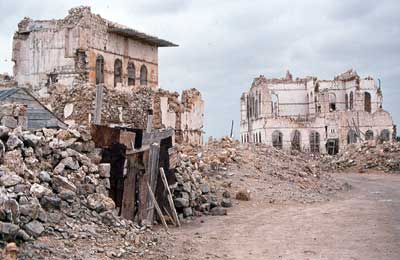
. . . quite a weekend.
Wednesday, May 23, 2007
All the Saints
What some people say they love about their religion is that they can go into any place of worship that takes the same name, anywhere in the world, and have the same religious experience.
What I love about religion is that wherever I am, I can have a completely different experience - whether I am returning to a favorite local church, visiting an Islamic center, or coordinating a meditation group. It is never the same.
Take this week, for example. Although I have been to All Saints Anglican churches before, I have NEVER been to this All Saints Cathedral, nor to a worship like this. THIS All Saints in Amarat neighborhood of Khartoum is a relocation of the community after its first building was taken over by certain authorities who shall not be named. Through its gates was a considerable cement structure, recognizably a church, even in this land of surprising architecture. Through the front doors the pastor greeted us enthusiastically. This was his seventh service for the day: two in English, one in Arabic, other Sudanese languages interspersed. He glistened slightly from this exertion.
We took our book of prayer, songbook and Bible to our seats (near the back) and looked around. Aside from the children, I was the shortest person there. If not for the other 6 or so expats, I could have been the whitest. I was quite likely the only woman wearing pants, the only woman in neutral-colored clothing, and the only woman sitting right next to her husband. I swear I was the only woman sweating so much (no, the 6pm worship on this 120 degree day was NOT air conditioned - nor were the other 6 services, though . . .) but I didn't have the opportunity to really investigate.
We turned to the Service of Evening Prayer. The synthesizer started: steel band sounds, static, and electric organ all at once. The choir (two soulful young women with shrill high voices) started us in our first hymn. We sang about how pure and white was Jesus. At this time, even more than ever before, I was struck by how ironic, ethnocentric, and inaccurate such descriptions of Christ are.
The sermon, based on that esoteric passage from Ezekiel about dry bones, was preached (Amen), was preached (Hallelujah), by a man with a powerful voice from Nigeria. He went on and on about how dry bones can be (yes they can, Hallelujah), can be re-enlivened by the Holy Spirit (Amen), with the power of the word. Although we were a bit put off by our preacher's implication that all those not practicing Christianity in this country were dry, dry, dry bones, we were also able to see the larger message. Even those who have lost everything, which means something in this town some 600 miles from Darfur, can be restored with hope. Hope is a powerful, powerful thing.
We sang again. The hair on the back of my neck standing up as the choir starts in with their polyphonic harmony. There is a breeze . . .When it is time to pray, we are all asked to raise our hands. Not just to make a little steeple with our fingers pointed up in front of our chests, no. We were to raise our hands up in the air and pray! We prayed for our leaders, for other world leaders, for people in the community, for people across the country. We prayed long and strong with our hands in the air.
And nobody minded that we had been there two hours in the stifling heat with no Sure antiperspirant in sight . . .
What I love about religion is that wherever I am, I can have a completely different experience - whether I am returning to a favorite local church, visiting an Islamic center, or coordinating a meditation group. It is never the same.
Take this week, for example. Although I have been to All Saints Anglican churches before, I have NEVER been to this All Saints Cathedral, nor to a worship like this. THIS All Saints in Amarat neighborhood of Khartoum is a relocation of the community after its first building was taken over by certain authorities who shall not be named. Through its gates was a considerable cement structure, recognizably a church, even in this land of surprising architecture. Through the front doors the pastor greeted us enthusiastically. This was his seventh service for the day: two in English, one in Arabic, other Sudanese languages interspersed. He glistened slightly from this exertion.
We took our book of prayer, songbook and Bible to our seats (near the back) and looked around. Aside from the children, I was the shortest person there. If not for the other 6 or so expats, I could have been the whitest. I was quite likely the only woman wearing pants, the only woman in neutral-colored clothing, and the only woman sitting right next to her husband. I swear I was the only woman sweating so much (no, the 6pm worship on this 120 degree day was NOT air conditioned - nor were the other 6 services, though . . .) but I didn't have the opportunity to really investigate.
We turned to the Service of Evening Prayer. The synthesizer started: steel band sounds, static, and electric organ all at once. The choir (two soulful young women with shrill high voices) started us in our first hymn. We sang about how pure and white was Jesus. At this time, even more than ever before, I was struck by how ironic, ethnocentric, and inaccurate such descriptions of Christ are.
The sermon, based on that esoteric passage from Ezekiel about dry bones, was preached (Amen), was preached (Hallelujah), by a man with a powerful voice from Nigeria. He went on and on about how dry bones can be (yes they can, Hallelujah), can be re-enlivened by the Holy Spirit (Amen), with the power of the word. Although we were a bit put off by our preacher's implication that all those not practicing Christianity in this country were dry, dry, dry bones, we were also able to see the larger message. Even those who have lost everything, which means something in this town some 600 miles from Darfur, can be restored with hope. Hope is a powerful, powerful thing.
We sang again. The hair on the back of my neck standing up as the choir starts in with their polyphonic harmony. There is a breeze . . .When it is time to pray, we are all asked to raise our hands. Not just to make a little steeple with our fingers pointed up in front of our chests, no. We were to raise our hands up in the air and pray! We prayed for our leaders, for other world leaders, for people in the community, for people across the country. We prayed long and strong with our hands in the air.
And nobody minded that we had been there two hours in the stifling heat with no Sure antiperspirant in sight . . .
Saturday, May 19, 2007
The Weekend - A Visit to the National Museum
T.G.I.T. Thursday night is the start of our weekends here in Khartoum. Fridays are days for family, gathering with friends, and prayer.
We spent our first Friday (Yom al Juma'ah - day of gathering) with a new friend from the Embassy. She took us to the swanky new bakery and coffeeshop, "Ozone." This classy outdoor joint is located smack in the middle of a roundabout. Really. The grounds are shaded by a few large trees and the traffic isn't too terribly loud. The coffee and pastries are delectable, though, so we won't hesitate to return.
After breakfast we headed to the National Museum of Sudan. For about $0.50 we were invited to tromp around reconstructed pharaonic temples, peruse the ancient and still untranslated Meroitic engravings, and enjoy the rich painting and low relief carvings. We could walk right up and touch the stones if we wanted - but we restrained ourselves.
In fact, we were not the only ones who were so tempted - graffiti adorned much of the rougher and outer walls. Most astonishing were the tags in French dating from the Napoleonic era. Can't you just imagine an early 19th century French legionnaire cruising up the Nile on a break from the Battle of the Pyramids to admire and disfigure pieces of Sudanese Kushitic history?!
Other highlights included:
1. noticing the familiar Egyptian pharaonic style interningling with a freer, more fluid expression in carvings of kings (and occasionally queens) in motion (running, on tip-toe, arms up) in contrast to the stoic, frozen poses found farther down the Nile
2. the lion-headed Shesmu, God of the Underworld (not frequently present in Egyptian representations)
3. varieties of body type and haristyle demonstrating the intersecting of northern and southern ancient peoples
We saw a lot more of the city today and are beginning to glimpse the possibility of finding our own way around soon . . . but not too soon! We're taking it day by day . . .
We spent our first Friday (Yom al Juma'ah - day of gathering) with a new friend from the Embassy. She took us to the swanky new bakery and coffeeshop, "Ozone." This classy outdoor joint is located smack in the middle of a roundabout. Really. The grounds are shaded by a few large trees and the traffic isn't too terribly loud. The coffee and pastries are delectable, though, so we won't hesitate to return.
After breakfast we headed to the National Museum of Sudan. For about $0.50 we were invited to tromp around reconstructed pharaonic temples, peruse the ancient and still untranslated Meroitic engravings, and enjoy the rich painting and low relief carvings. We could walk right up and touch the stones if we wanted - but we restrained ourselves.
In fact, we were not the only ones who were so tempted - graffiti adorned much of the rougher and outer walls. Most astonishing were the tags in French dating from the Napoleonic era. Can't you just imagine an early 19th century French legionnaire cruising up the Nile on a break from the Battle of the Pyramids to admire and disfigure pieces of Sudanese Kushitic history?!
Other highlights included:
1. noticing the familiar Egyptian pharaonic style interningling with a freer, more fluid expression in carvings of kings (and occasionally queens) in motion (running, on tip-toe, arms up) in contrast to the stoic, frozen poses found farther down the Nile
2. the lion-headed Shesmu, God of the Underworld (not frequently present in Egyptian representations)
3. varieties of body type and haristyle demonstrating the intersecting of northern and southern ancient peoples
We saw a lot more of the city today and are beginning to glimpse the possibility of finding our own way around soon . . . but not too soon! We're taking it day by day . . .
Saturday, May 12, 2007
Groceries
There are four "super"markets here in Khartoum. We visited one our second day here and picked up some necessities. However, this first experience was far from super.
First, it smelled like rotting meat. Ah yes, a pleasant way to begin a blog entry isn't it?! Sorry, unfortunately, it doesn't get much sweeter. As I said before, everything is covered in dust: the packages, cans, shelves, and anything fresh that is out on display. The shelves are jam packed from floor to ceiling. The store is small and the prices are exorbitant!
I reached for a bottle of shampoo (small) and calculated it to be just over 8 dollars. Cereal (average box) ? Almost ten. Cookies are cheap, so we'll be eating a lot of those . . . jam too . . . There is no produce at the "super" market. We had to cross the street to a small road side stand for that. (Our driver wanted to drive us, so concerned was he for our safety negotiating the traffic, but it all turned out fine). The fruits and veggies were wrinkly and dirty; we bought only three pears and a mango. Nutella (giant size) abounds, though, so I won't complain too much. It does run you ten dollars a jar - but that's a small price to pay for so much enjoyment.
The funniest thing about buying groceries here is that the prices are given in different currencies than anyone uses for anything else. The currency here is the Sudanese Pound. There are still a significant number of Sudanese Dinars floating around out there, but they're being phased out. Dinars correspond to pounds like cents to a dollar, so it's not too hard to calculate cost with either old or new money.
However, some people, grocery store owners included, still give the prices in "Old Pounds". These are 1/10 of a Dinar. If you're not paying attention, and used to being quoted prices in Dinar, you could easily end up paying $1.50 for that small bread roll that should have cost you $0.15. The seller won't always correct your mistake, so if you give 10 times what they are asking just because you misunderstand the currency they're using - too bad for you.
Back to the groceries. Today we made another run to expand our understanding of the local shopping options. We discovered Afra Mall. Afra Mall has everything we could ask for. The meat is refrigerated, the aisles are spacious, the selection is varied, there is a small amount of produce inside the store . . . BUT - it is NOT AIR CONDITIONED! Yeah. For those of you who get weak knees at Costco from the work of shopping there, Afra Mall is not for you. This experience could wear down even the toughest of shoppers. We're talking a giant warehouse with corugated metal walls and roof, in the middle of one of the hottest, driest areas of the world, packed with people trying to get their food and get out, and it is NOT AIR CONDITIONED!
The little Turkish bakery and kushuk ("convenience shop", roughly equivalent to a bodega) around the dusty corner from our home are starting to look better and better. Who ever said we couldn't live pretty well on cookies, jam, and Nutella?!?!
First, it smelled like rotting meat. Ah yes, a pleasant way to begin a blog entry isn't it?! Sorry, unfortunately, it doesn't get much sweeter. As I said before, everything is covered in dust: the packages, cans, shelves, and anything fresh that is out on display. The shelves are jam packed from floor to ceiling. The store is small and the prices are exorbitant!
I reached for a bottle of shampoo (small) and calculated it to be just over 8 dollars. Cereal (average box) ? Almost ten. Cookies are cheap, so we'll be eating a lot of those . . . jam too . . . There is no produce at the "super" market. We had to cross the street to a small road side stand for that. (Our driver wanted to drive us, so concerned was he for our safety negotiating the traffic, but it all turned out fine). The fruits and veggies were wrinkly and dirty; we bought only three pears and a mango. Nutella (giant size) abounds, though, so I won't complain too much. It does run you ten dollars a jar - but that's a small price to pay for so much enjoyment.
The funniest thing about buying groceries here is that the prices are given in different currencies than anyone uses for anything else. The currency here is the Sudanese Pound. There are still a significant number of Sudanese Dinars floating around out there, but they're being phased out. Dinars correspond to pounds like cents to a dollar, so it's not too hard to calculate cost with either old or new money.
However, some people, grocery store owners included, still give the prices in "Old Pounds". These are 1/10 of a Dinar. If you're not paying attention, and used to being quoted prices in Dinar, you could easily end up paying $1.50 for that small bread roll that should have cost you $0.15. The seller won't always correct your mistake, so if you give 10 times what they are asking just because you misunderstand the currency they're using - too bad for you.
Back to the groceries. Today we made another run to expand our understanding of the local shopping options. We discovered Afra Mall. Afra Mall has everything we could ask for. The meat is refrigerated, the aisles are spacious, the selection is varied, there is a small amount of produce inside the store . . . BUT - it is NOT AIR CONDITIONED! Yeah. For those of you who get weak knees at Costco from the work of shopping there, Afra Mall is not for you. This experience could wear down even the toughest of shoppers. We're talking a giant warehouse with corugated metal walls and roof, in the middle of one of the hottest, driest areas of the world, packed with people trying to get their food and get out, and it is NOT AIR CONDITIONED!
The little Turkish bakery and kushuk ("convenience shop", roughly equivalent to a bodega) around the dusty corner from our home are starting to look better and better. Who ever said we couldn't live pretty well on cookies, jam, and Nutella?!?!
Thursday, May 10, 2007
Touching Down
Sand, taupe, brown, khaki, tan, wheat, caramel, buff, peach, camel, beige, terra-cotta . . .
We are touching down in Khartoum, Sudan - gliding over a landscape of tawny desert. At first there is only sand and rock. Then, we come to neat squares of green and yellows. Finally, we start to see city buildings - spaced far apart. Dirt roads, occasionally spare shrubs, homes . . . then BLUE! The river Nile. This far upstream the Blue and White Niles are clear and stunning. Cooling to the eyes after miles of burnt hues. . .
We are on the ground, but it does not yet feel real. We roll by white U.N. airplanes, more than I have ever seen in my life. By outbuildings, and nearby homes. The airport in Khartoum is right in the middle of the city.
Stepping out of the plane, I feel like I have just walked into my hair dryer. My nostrils filled with warm dryness. All around there is fine apricot-colored dust. On the ground, on the cars, on every surface and paper, the leaves of trees, and even my skin. It is unavoidable.
We head into the city toward our new home. When cars stop on the road in front of our Landcruiser, we just fourwheel around them off the side of the road. Traffic is congested in this hot city, but no one is really in a hurry anyway. We wait.
In the streets are women in brightly colored thoubs; the long one-piece garments are wrapped gracefully around and around from head to toe. They are the flowers in this desert city. The men in uniforms of white gelabiyyas or dark slacks and light colored dress shirts. It is hot. People move slowly. The shade is crowded.
Enfolded in the curve of the Ethiopian Blue Nile as it meets the White Nile flowing North from Uganda, Khartoum rests. It is a quiet city. Developing, moving, growing, but quiet for now. At night, it is dark. The neon lights of other North African cities absent . . . only a few street lights, and security lamps on people's homes. During the day there is bustle, but at a pace hindered by temperatures of 50 degrees centigrade (upwards of 130 Fahrenheit).
Who knows what our post here will bring? At the moment we are simultaneously thrilled, tired, curious, surprised, hungry, encouraged, and awed. We are touching down, but still not fully grounded. We are eager to see what each new day has in store.
We are touching down in Khartoum, Sudan - gliding over a landscape of tawny desert. At first there is only sand and rock. Then, we come to neat squares of green and yellows. Finally, we start to see city buildings - spaced far apart. Dirt roads, occasionally spare shrubs, homes . . . then BLUE! The river Nile. This far upstream the Blue and White Niles are clear and stunning. Cooling to the eyes after miles of burnt hues. . .
We are on the ground, but it does not yet feel real. We roll by white U.N. airplanes, more than I have ever seen in my life. By outbuildings, and nearby homes. The airport in Khartoum is right in the middle of the city.
Stepping out of the plane, I feel like I have just walked into my hair dryer. My nostrils filled with warm dryness. All around there is fine apricot-colored dust. On the ground, on the cars, on every surface and paper, the leaves of trees, and even my skin. It is unavoidable.
We head into the city toward our new home. When cars stop on the road in front of our Landcruiser, we just fourwheel around them off the side of the road. Traffic is congested in this hot city, but no one is really in a hurry anyway. We wait.
In the streets are women in brightly colored thoubs; the long one-piece garments are wrapped gracefully around and around from head to toe. They are the flowers in this desert city. The men in uniforms of white gelabiyyas or dark slacks and light colored dress shirts. It is hot. People move slowly. The shade is crowded.
Enfolded in the curve of the Ethiopian Blue Nile as it meets the White Nile flowing North from Uganda, Khartoum rests. It is a quiet city. Developing, moving, growing, but quiet for now. At night, it is dark. The neon lights of other North African cities absent . . . only a few street lights, and security lamps on people's homes. During the day there is bustle, but at a pace hindered by temperatures of 50 degrees centigrade (upwards of 130 Fahrenheit).
Who knows what our post here will bring? At the moment we are simultaneously thrilled, tired, curious, surprised, hungry, encouraged, and awed. We are touching down, but still not fully grounded. We are eager to see what each new day has in store.
Friday, April 13, 2007
Less than one month to go
Dear Readers,
We are getting into crunch time. For a while there I thought that we were doing pretty well, getting informed on the region, watching movies about Sudan, having meetings with contacts who have been or will be in Khartoum . . . but boy . . . there is still so much to do and not much time to do it in!
This week we are trying to buy a car, arrange for the last bits of electronics neccessary for us to be able to stay in touch with all our friends and families, and plan for our own Bon Voyage party.
Next week we'll have to actually start arranging things to be packed - what comes with us, what goes to storage, and what gets shipped over land and sea (which we may never see again).
After that we'l have our party, the movers will come, and we'll live out of suitcases until the departure date . . . May 7.
Stay tuned for more and here's to hoping our visas get processed on time!
We are getting into crunch time. For a while there I thought that we were doing pretty well, getting informed on the region, watching movies about Sudan, having meetings with contacts who have been or will be in Khartoum . . . but boy . . . there is still so much to do and not much time to do it in!
This week we are trying to buy a car, arrange for the last bits of electronics neccessary for us to be able to stay in touch with all our friends and families, and plan for our own Bon Voyage party.
Next week we'll have to actually start arranging things to be packed - what comes with us, what goes to storage, and what gets shipped over land and sea (which we may never see again).
After that we'l have our party, the movers will come, and we'll live out of suitcases until the departure date . . . May 7.
Stay tuned for more and here's to hoping our visas get processed on time!
Sunday, February 18, 2007
Subscribe to:
Comments (Atom)