Sunday, May 27, 2007

36 Hours to Port Sudan

. . . well that's how long it takes to go by bus.

This weekend while E was away on business, I took my first trip outside the capital city. My departure from Khartoum was scheduled for 2pm . . . and 6 hours later I was still at the airport . . .

6 hours of flight delay, 1 1/2 hours flying time, 2 1/2 hours waiting for the resort manager to show up and open his office, 2 hours negotiating with authorities to get the right permits to travel to the resort, 3 hours waiting for the resort driver, and 1 1/2 hours driving up to the resort, I was finally in the Red Sea snorkeling with the fishies!

So was it worth it?!?! You bet. Port Sudan may never be the same . . .

This weekend four khawagas from Khartoum ventured east for a coastal getaway. Port Sudan is the capital of the Red Sea state of Sudan. It is gateway for travellers and goods making their way to and from the East. The original staging point for traders and pilgrims heading to Arabia was Suakin, about 45 minutes south of the modern port, but just after the turn of the 20th century the British founded Port Sudan seeking deeper waters to accommodate their merchant fleets.


We were seeking sun, sand, and sea - and maybe a little relaxation. We booked rooms with a view, and from inside the hotel, we could have been in any one of a thousand places. But outside, it was a whole different world. For starters, we were likely the only four westerners in town. Midday Saturday a boatload of Italian scuba divers disembarked, but they ventured only as far as the hotel pool and restaurant, then back to their vessel.


The sand and sea proved harder to get to than we would have thought. We could see it from our hotel windows, and could walk along the port corniche, but to actually get wet required quite an adventure.

There is effectively no beach in Port Sudan. The city's waterfront is industrial rather than touristic and although it is marketed as the gateway to the Red Sea, we found that we had to travel to a separate resort some 40 km north of this second largest city in Sudan (after the greater metropolitan area of Khartoum/Omdurman/Khartoum North) to actually get in the water.

But this was after we:
  • piled all four of us into the back of a tuk tuk (twice)
  • checked out the central market
  • honed our snorkeling skills and lounged by the pool
  • debated with the authorities (no photo)
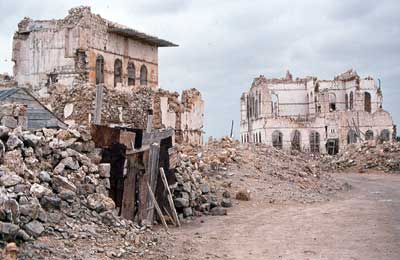
  • explored the ruins of Suakin
    and more.

. . . quite a weekend.

Wednesday, May 23, 2007

All the Saints

What some people say they love about their religion is that they can go into any place of worship that takes the same name, anywhere in the world, and have the same religious experience.

What I love about religion is that wherever I am, I can have a completely different experience - whether I am returning to a favorite local church, visiting an Islamic center, or coordinating a meditation group. It is never the same.

Take this week, for example. Although I have been to All Saints Anglican churches before, I have NEVER been to this All Saints Cathedral, nor to a worship like this. THIS All Saints in Amarat neighborhood of Khartoum is a relocation of the community after its first building was taken over by certain authorities who shall not be named. Through its gates was a considerable cement structure, recognizably a church, even in this land of surprising architecture. Through the front doors the pastor greeted us enthusiastically. This was his seventh service for the day: two in English, one in Arabic, other Sudanese languages interspersed. He glistened slightly from this exertion.

We took our book of prayer, songbook and Bible to our seats (near the back) and looked around. Aside from the children, I was the shortest person there. If not for the other 6 or so expats, I could have been the whitest. I was quite likely the only woman wearing pants, the only woman in neutral-colored clothing, and the only woman sitting right next to her husband. I swear I was the only woman sweating so much (no, the 6pm worship on this 120 degree day was NOT air conditioned - nor were the other 6 services, though . . .) but I didn't have the opportunity to really investigate.

We turned to the Service of Evening Prayer. The synthesizer started: steel band sounds, static, and electric organ all at once. The choir (two soulful young women with shrill high voices) started us in our first hymn. We sang about how pure and white was Jesus. At this time, even more than ever before, I was struck by how ironic, ethnocentric, and inaccurate such descriptions of Christ are.

The sermon, based on that esoteric passage from Ezekiel about dry bones, was preached (Amen), was preached (Hallelujah), by a man with a powerful voice from Nigeria. He went on and on about how dry bones can be (yes they can, Hallelujah), can be re-enlivened by the Holy Spirit (Amen), with the power of the word. Although we were a bit put off by our preacher's implication that all those not practicing Christianity in this country were dry, dry, dry bones, we were also able to see the larger message. Even those who have lost everything, which means something in this town some 600 miles from Darfur, can be restored with hope. Hope is a powerful, powerful thing.

We sang again. The hair on the back of my neck standing up as the choir starts in with their polyphonic harmony. There is a breeze . . .When it is time to pray, we are all asked to raise our hands. Not just to make a little steeple with our fingers pointed up in front of our chests, no. We were to raise our hands up in the air and pray! We prayed for our leaders, for other world leaders, for people in the community, for people across the country. We prayed long and strong with our hands in the air.

And nobody minded that we had been there two hours in the stifling heat with no Sure antiperspirant in sight . . .

Saturday, May 19, 2007

The Weekend - A Visit to the National Museum

T.G.I.T. Thursday night is the start of our weekends here in Khartoum. Fridays are days for family, gathering with friends, and prayer.

We spent our first Friday (Yom al Juma'ah - day of gathering) with a new friend from the Embassy. She took us to the swanky new bakery and coffeeshop, "Ozone." This classy outdoor joint is located smack in the middle of a roundabout. Really. The grounds are shaded by a few large trees and the traffic isn't too terribly loud. The coffee and pastries are delectable, though, so we won't hesitate to return.

After breakfast we headed to the National Museum of Sudan. For about $0.50 we were invited to tromp around reconstructed pharaonic temples, peruse the ancient and still untranslated Meroitic engravings, and enjoy the rich painting and low relief carvings. We could walk right up and touch the stones if we wanted - but we restrained ourselves.

In fact, we were not the only ones who were so tempted - graffiti adorned much of the rougher and outer walls. Most astonishing were the tags in French dating from the Napoleonic era. Can't you just imagine an early 19th century French legionnaire cruising up the Nile on a break from the Battle of the Pyramids to admire and disfigure pieces of Sudanese Kushitic history?!

Other highlights included:

1. noticing the familiar Egyptian pharaonic style interningling with a freer, more fluid expression in carvings of kings (and occasionally queens) in motion (running, on tip-toe, arms up) in contrast to the stoic, frozen poses found farther down the Nile

2. the lion-headed Shesmu, God of the Underworld (not frequently present in Egyptian representations)

3. varieties of body type and haristyle demonstrating the intersecting of northern and southern ancient peoples

We saw a lot more of the city today and are beginning to glimpse the possibility of finding our own way around soon . . . but not too soon! We're taking it day by day . . .

Saturday, May 12, 2007

Groceries

There are four "super"markets here in Khartoum. We visited one our second day here and picked up some necessities. However, this first experience was far from super.

First, it smelled like rotting meat. Ah yes, a pleasant way to begin a blog entry isn't it?! Sorry, unfortunately, it doesn't get much sweeter. As I said before, everything is covered in dust: the packages, cans, shelves, and anything fresh that is out on display. The shelves are jam packed from floor to ceiling. The store is small and the prices are exorbitant!

I reached for a bottle of shampoo (small) and calculated it to be just over 8 dollars. Cereal (average box) ? Almost ten. Cookies are cheap, so we'll be eating a lot of those . . . jam too . . . There is no produce at the "super" market. We had to cross the street to a small road side stand for that. (Our driver wanted to drive us, so concerned was he for our safety negotiating the traffic, but it all turned out fine). The fruits and veggies were wrinkly and dirty; we bought only three pears and a mango. Nutella (giant size) abounds, though, so I won't complain too much. It does run you ten dollars a jar - but that's a small price to pay for so much enjoyment.

The funniest thing about buying groceries here is that the prices are given in different currencies than anyone uses for anything else. The currency here is the Sudanese Pound. There are still a significant number of Sudanese Dinars floating around out there, but they're being phased out. Dinars correspond to pounds like cents to a dollar, so it's not too hard to calculate cost with either old or new money.

However, some people, grocery store owners included, still give the prices in "Old Pounds". These are 1/10 of a Dinar. If you're not paying attention, and used to being quoted prices in Dinar, you could easily end up paying $1.50 for that small bread roll that should have cost you $0.15. The seller won't always correct your mistake, so if you give 10 times what they are asking just because you misunderstand the currency they're using - too bad for you.

Back to the groceries. Today we made another run to expand our understanding of the local shopping options. We discovered Afra Mall. Afra Mall has everything we could ask for. The meat is refrigerated, the aisles are spacious, the selection is varied, there is a small amount of produce inside the store . . . BUT - it is NOT AIR CONDITIONED! Yeah. For those of you who get weak knees at Costco from the work of shopping there, Afra Mall is not for you. This experience could wear down even the toughest of shoppers. We're talking a giant warehouse with corugated metal walls and roof, in the middle of one of the hottest, driest areas of the world, packed with people trying to get their food and get out, and it is NOT AIR CONDITIONED!

The little Turkish bakery and kushuk ("convenience shop", roughly equivalent to a bodega) around the dusty corner from our home are starting to look better and better. Who ever said we couldn't live pretty well on cookies, jam, and Nutella?!?!

Thursday, May 10, 2007

Touching Down

Sand, taupe, brown, khaki, tan, wheat, caramel, buff, peach, camel, beige, terra-cotta . . .

We are touching down in Khartoum, Sudan - gliding over a landscape of tawny desert. At first there is only sand and rock. Then, we come to neat squares of green and yellows. Finally, we start to see city buildings - spaced far apart. Dirt roads, occasionally spare shrubs, homes . . . then BLUE! The river Nile. This far upstream the Blue and White Niles are clear and stunning. Cooling to the eyes after miles of burnt hues. . .

We are on the ground, but it does not yet feel real. We roll by white U.N. airplanes, more than I have ever seen in my life. By outbuildings, and nearby homes. The airport in Khartoum is right in the middle of the city.

Stepping out of the plane, I feel like I have just walked into my hair dryer. My nostrils filled with warm dryness. All around there is fine apricot-colored dust. On the ground, on the cars, on every surface and paper, the leaves of trees, and even my skin. It is unavoidable.

We head into the city toward our new home. When cars stop on the road in front of our Landcruiser, we just fourwheel around them off the side of the road. Traffic is congested in this hot city, but no one is really in a hurry anyway. We wait.

In the streets are women in brightly colored thoubs; the long one-piece garments are wrapped gracefully around and around from head to toe. They are the flowers in this desert city. The men in uniforms of white gelabiyyas or dark slacks and light colored dress shirts. It is hot. People move slowly. The shade is crowded.

Enfolded in the curve of the Ethiopian Blue Nile as it meets the White Nile flowing North from Uganda, Khartoum rests. It is a quiet city. Developing, moving, growing, but quiet for now. At night, it is dark. The neon lights of other North African cities absent . . . only a few street lights, and security lamps on people's homes. During the day there is bustle, but at a pace hindered by temperatures of 50 degrees centigrade (upwards of 130 Fahrenheit).

Who knows what our post here will bring? At the moment we are simultaneously thrilled, tired, curious, surprised, hungry, encouraged, and awed. We are touching down, but still not fully grounded. We are eager to see what each new day has in store.